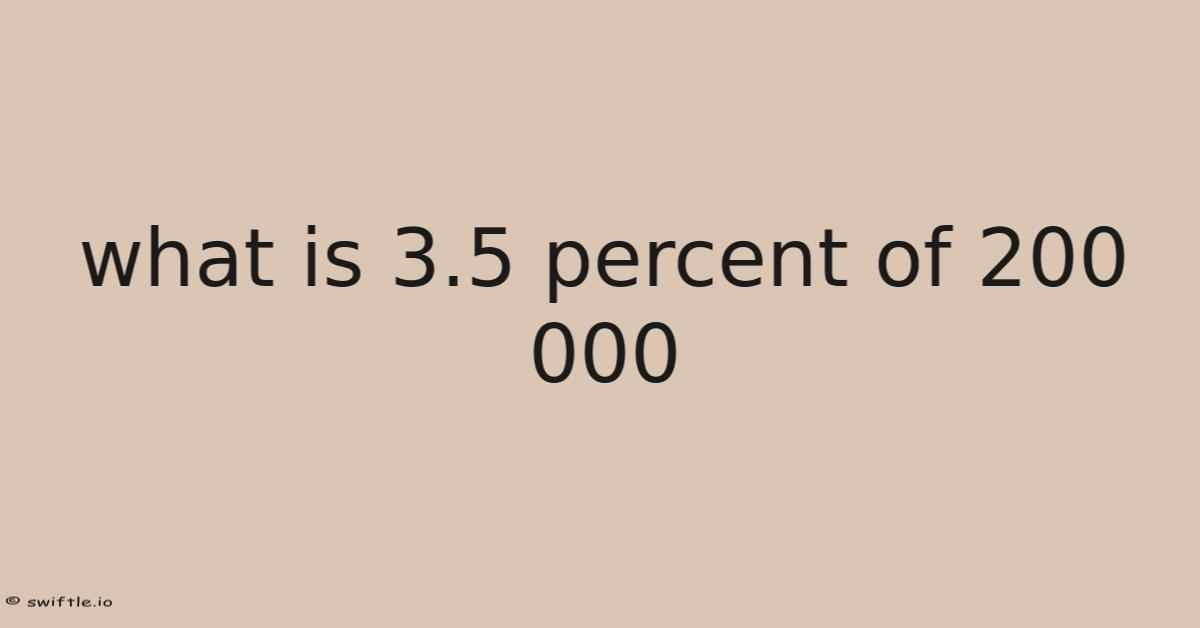
What Is 3.5 Percent of 200,000? – A Straight‑Talk Guide to Percentage Calculations
You’ve probably seen the number 200,000 pop up in a job offer, a real‑estate listing, or a donation goal, and then someone mentions “3.That's why 5 percent of that. Now, ” What does it really mean? Let’s break it down in a way that feels less like a math lecture and more like a friendly chat over coffee.
What Is 3.5 Percent of 200,000
When someone asks “what is 3.Also, ” they’re really asking for a portion* of a larger whole. Here's the thing — think of it like slicing a pizza: if the pizza has 200,000 slices (just kidding), 3. Think about it: 5 percent of 200,000? 5 percent would be the size of a tiny sliver that represents that exact share.
Understanding Percentages
A percentage is simply a way to express a part‑to‑whole relationship out of 100. Also, the word percent* comes from Latin “per centum,” meaning “by the hundred. ” So 3.5 percent literally means 3.5 out of every 100 parts. In practice, that translates to a decimal of 0.035 when you need to do the math.
The Math Behind It
The calculation itself is straightforward:
- Convert the percent to a decimal – divide 3.5 by 100, giving you 0.035.2. Multiply by the total amount – 0.035 × 200,000 = 7,000.
So, 3.5 percent of 200,000 is 7,000. That’s the number you’ll see in salary bonuses, commission checks, or even the amount of a down‑payment on a house.
Why It Matters / Why People Care
You might think this is just a classroom problem, but the truth is, percentages show up everywhere in daily life. Understanding them can save you money, help you negotiate better, and give you a clearer picture of your finances.
Real‑World Scenarios
- Salary negotiations – A 3.5% raise on a $200,000 salary means an extra $7,000 per year. Knowing the exact figure helps you compare offers quickly.
- Sales and discounts – A store advertising “30% off” on a $200,000 item (yes, luxury goods can be pricey) means you’ll pay $140,000. The same logic applies to smaller purchases.
- Tax calculations – Your property tax might be 3.5% of an assessed value of $200,000, which again equals $7,000.
- Investment returns – If a fund returns 3.5% annually on a $200,000 investment, you’ll earn $7,000 that year.
When people skip the percentage step, they often misjudge how much they’ll actually pay or earn. That can lead to budgeting nightmares or accepting a raise that looks bigger than it really is.
How It Works (or How to Do It)
Let’s walk through the calculation step by step, plus a few shortcuts you can use when the numbers get big.
Converting Percent to Decimal
The first move is to turn the percentage into a decimal because math works best with plain numbers. The rule is simple: divide by 100. You can do this by moving the decimal point two places to the left.
- 3.5% → 0.035
If you’re dealing with a whole number like 10%, just remember it’s 0.10. For 0.On the flip side, 5%, it’s 0. Now, 005. The pattern holds for any percent.
Multiplying by the Whole
Multiplying by the Whole
Once you’ve converted the percentage to its decimal form, the next step is to multiply it by the total amount. This is where the magic happens, turning abstract percentages into concrete numbers you can use. Let’s take another example to illustrate: **What’s 2.5% of 150,000?
- Convert 2.5% to a decimal: 0.025.2. Multiply by 150,000: 0.025 × 150,000 = 3,750.
For larger numbers, breaking the decimal into manageable chunks can simplify the process. Take this case: 0.035 × 200,000 can be reimagined as (0.
Breaking Down Large Multiplications
For larger numbers, breaking the decimal into manageable chunks can simplify the process. 005** (0.So let’s revisit 0. 035 × 200,000 by splitting the decimal into two parts:
- 0.03 (3%) and **0.5%).
Multiply each part separately:
1.Because of that, 0. 03 × 200,000 = 6,000
2.0.
Add the results: 6,000 + 1,000 = 7,000. This method reduces mental math strain and minimizes errors, especially when dealing with complex percentages or large totals.
Common Pitfalls and How to Avoid Them
- Misplacing the decimal point: When converting percentages to decimals, ensure you move the decimal two places correctly. As an example, 3.5% becomes 0.035, not 0.35 or 3.5.
- Rounding too early: Keep extra decimal places during calculations to maintain accuracy. Round only the final result.
- Ignoring the context: Always double-check if the percentage applies to the correct base amount. A 3.5% tax on $200,000 is straightforward, but compound percentages (e.g., annual interest over multiple years) require more advanced formulas.
Conclusion
Mastering percentage calculations isn’t just about crunching numbers—it’s about making informed decisions. Whether you’re evaluating a job offer, comparing loan terms, or planning a budget, knowing how to translate percentages into tangible values empowers you to act with confidence. Consider this: by breaking down complex problems into simple steps and avoiding common mistakes, you’ll deal with financial scenarios with ease. The next time you encounter a percentage, remember: it’s not just a number—it’s a tool for clarity and control.
Continue exploring with our guides on how long would it take to count to a million and how many teaspoons in a tablespoon.
Advanced Techniques for Complex Percentages
When you’re comfortable with the basics, the next step is to tackle scenarios that involve multiple percentages or variable rates.
1. Successive Increases – Imagine a product price that rises by 5 % each quarter for a year. Instead of applying each 5 % increase separately, you can multiply the original amount by (1.05) four times:
[
\text{Final Price}= \text{Initial} \times (1.05)^4
]
This exponential approach saves time and reduces the chance of cumulative rounding errors.
2. Percentage of a Percentage – Sometimes you need a portion of a portion. Take this: “3 % of 12 % of 500.” Convert each percentage to a decimal and multiply:
[
0.03 \times 0.12 \times 500 = 1.8
]
Understanding that “of” translates to multiplication makes these nested calculations straightforward.
3. Reverse Engineering – If you know the result of a percentage operation and need the original value, rearrange the formula. Suppose a discount saved you $1,200, which represented a 15 % reduction. The original price (P) satisfies:
[
0.15 \times P = 1{,}200 ;;\Longrightarrow;; P = \frac{1{,}200}{0.15}=8{,}000
]
Working backwards is a handy skill for budgeting and price negotiations.
Everyday Tools That Make Percentages Effortless
- Spreadsheet shortcuts – In Excel or Google Sheets, the formula
=A1*0.035instantly converts a cell containing a raw number into its 3.5 % equivalent. You can drag the formula down a column to process dozens of figures at once. - Calculator functions – Many scientific calculators have a dedicated “%” key that automatically treats the entered number as a percentage of the displayed value. To give you an idea, typing
2500 %followed by=will return250when the next operation is multiplication. - Mobile apps – Dedicated finance apps often include a “percentage calculator” that handles tax, tip, and discount calculations with a single tap, letting you focus on the decision rather than the arithmetic.
Real‑World Case Study: Negotiating a Salary Raise
Suppose you receive a job offer with a base salary of $78,000 and a performance bonus that is advertised as “up to 4 % of your annual compensation.” To gauge the maximum possible earnings:
- Convert 4 % to a decimal: (0.04).
- Multiply by the base salary: (0.04 \times 78{,}000 = 3{,}120).
- Add the bonus to the base: (78{,}000 + 3{,}120 = 81{,}120).
If the employer later offers a 3 % annual raise instead, the new salary would be:
[
78{,}000 \times 1.03 = 80{,}340
]
Comparing the two pathways—bonus versus raise—lets you evaluate which option yields a higher total compensation over the same period.
Quick‑Reference Cheat Sheet
| Task | Shortcut | Example |
|---|---|---|
| Convert % → decimal | Move decimal two places left | 12 % → 0.12 |
| Find % of a number | Multiply decimal by number | 0.12 × 250 |
| Find % → decimal | Divide by 100 or move decimal left twice | 0.12 → 12 % | | Calculate % increase | (\frac{\text{New} - \text{Original}}{\text{Original}} \times 100) | (\frac{150-100}{100} \times 100 = 50%) | | Calculate % decrease | (\frac{\text{Original} - \text{New}}{\text{Original}} \times 100) | (\frac{100-80}{100} \times 100 = 20%) | | Quick mental math | 10% = divide by 10; 5% = half of 10% | 10% of 200 = 20 |
The beauty of percentages lies in their versatility. Whether you’re analyzing financial reports, adjusting recipes, or interpreting survey data, these foundational skills empower you to make informed decisions with confidence. The key is not just memorizing formulas but understanding the logic behind them—recognizing that percentages are simply fractions of 100, and “of” always signals multiplication. With practice, these calculations will become second nature, freeing your mind to focus on strategy rather than arithmetic.
In a world saturated with data, the ability to quickly and accurately manipulate percentages is more than
In a world saturated with data, the ability to quickly and accurately manipulate percentages is more than a convenience—it’s a critical skill that underpins sound decision‑making across virtually every domain. Whether you’re parsing a quarterly earnings report, calibrating a recipe, evaluating the effectiveness of a marketing campaign, or simply comparing two job offers, percentages provide a universal language for expressing proportions, changes, and relative magnitudes.
Mastering this language means internalizing a few core principles: percentages are fractions of 100, “of” always signals multiplication, and the difference between increase and decrease hinges on the direction of the subtraction. By rehearsing these concepts through everyday scenarios—like calculating tips, assessing discount savings, or projecting investment growth—you build mental shortcuts that speed up routine calculations and free cognitive resources for higher‑order thinking.
Practical strategies to sharpen your percent prowess include:
- Chunk your mental math – Break complex percentages into manageable parts (e.g., 17 % = 10 % + 5 % + 2 %).
- take advantage of technology wisely – Use calculator shortcuts and mobile apps for verification, but avoid over‑reliance that erodes intuition.
- Apply the “rule of 72” for quick investment estimates: dividing 72 by the annual interest rate gives the approximate years needed to double an amount.
When you combine these techniques with a solid conceptual foundation, percentages cease to be a source of anxiety and become a powerful analytical tool. In the end, fluency with percentages empowers you to decode data confidently, negotiate better outcomes, and make informed choices that drive personal and professional success.
Conclusion: Embracing the logic of percentages transforms raw numbers into actionable insight, turning the overwhelming flood of data into clear, decisive knowledge. By honing these skills today, you equip yourself to work through tomorrow’s quantitative challenges with poise and precision.
