Of course. Here is a complete pillar blog post on the topic, written in a genuine, human voice.
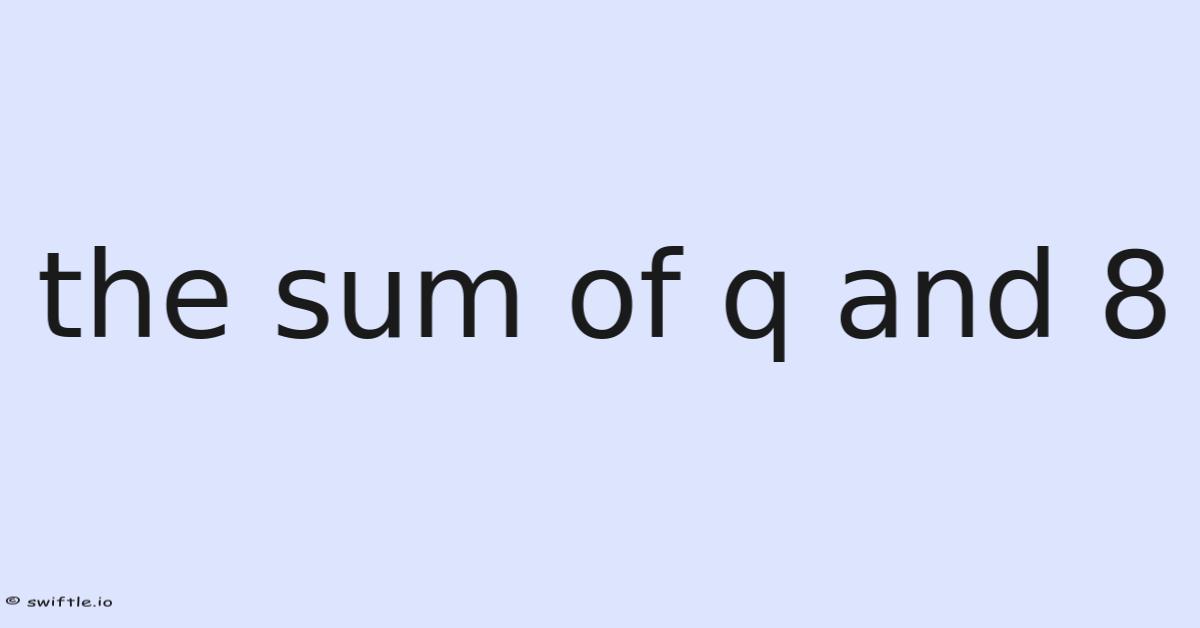
The Sum of q and 8: More Than Just a Simple Math Problem
You remember it, don't you? That moment in algebra class when the numbers stopped behaving. They got replaced by letters, and suddenly, "2 + 3" became "q + 8.Now, it’s not a trick question. Also, the answer is right there in the phrasing. " It feels abstract, almost like a trick. But what is the sum of q and 8, really? The sum is simply q + 8.
But if that’s all this is about, you’ve probably clicked away already. So let’s pause. Why does this seemingly trivial concept matter? Why do we spend time on something that looks like an unfinished thought? The truth is, "the sum of q and 8" is a foundational idea. It’s the first step into a world where we don’t just calculate answers; we build models, solve for unknowns, and describe relationships. Plus, it’s the grammar of a new language. And if you never quite got the hang of that grammar, you’re not alone. This is where most people get lost.
So, let’s break it down. Not as a textbook, but as a guide from someone who’s been in the trenches.
What Is the Sum of q and 8, Really?
At its core, "the sum of q and 8" is a phrase describing an operation. "Sum" is the key word here—it’s the mathematical term for addition. So, when someone says "the sum of A and B," they are simply telling you to add A and B together.
In this case, our two terms are:
- q: This is a variable*. A variable is a placeholder. It stands for a number we don’t know yet, or a number that can change. In practice, it’s the "unknown" or the "any number. On top of that, "
- 8: This is a constant*. It’s a fixed, known value.
Putting them together with the operation "sum" gives us the algebraic expression: q + 8.
Now, here’s the critical point that trips people up: you cannot simplify this any further. You can’t add q and 8 to get a single number because q is unknown. It’s like saying "the sum of a cat and a dog." You can’t combine them into a single entity called a "cat-dog." They remain distinct. Day to day, the expression q + 8 is the simplest, most accurate answer. It’s a complete and correct description of the relationship between the unknown q and the number 8.
The Language of Algebra: It's Just a Translation
Think of it as a direct translation from English to math.
- "The sum of" translates to
+. In real terms, * "q" translates toq. * "and" tells you to put the+between the things that follow. - "8" translates to
8.
So, "the sum of q and 8" becomes q + 8. It’s that straightforward. The confusion often comes from wanting to do something with the expression, to get a number out of it. But sometimes, the goal in algebra isn't to find a number, but to write a clear, mathematical sentence that represents a situation.
Why Does This Matter? The Real-World Power of an Expression
Okay, so you can write q + 8. Big deal, right? But this is where it gets interesting. This simple expression is the starting point for problem-solving. It allows us to model real-life situations where we have a partial amount and a fixed addition.
Imagine you’re at a store. You see a sign: "Buy a shirt and get $8 off." Let’s say the shirt’s price is unknown—we’ll call it q. Because of that, the final price you pay is the original price q minus the $8 discount. That’s q - 8.
But what if the deal was different? " Now, if you buy one shirt (price q), the total value of your purchase is the value of the shirt plus the gift card. And what if the sign said, "For every shirt you buy, we add a $8 gift card to your order. That total value is the sum of q and 8, or q + 8.
This is the power of variables. They let us write a general rule that works for any price q. If the shirt is $20, the total is 20 + 8 = $28. If the shirt is $50, the total is 50 + 8 = $58. Consider this: the expression q + 8 is a machine. You feed it a value for q, and it spits out the correct total. We use this kind of thinking in budgeting, programming, science, and engineering every single day.
How It Works: Building Blocks of Equations
The expression q + 8 is rarely the final destination. It’s usually a stepping stone. The real magic happens when we set this expression equal to something else, creating an equation*.
An equation is a statement that two things are equal. For example: q + 8 = 20.
Now, the goal is no longer just to write an expression; it’s to find the value of q that makes the statement true. This process is called solving the equation*.
To solve q + 8 = 20, we need to isolate q on one side of the equals sign. In practice, the opposite of adding 8 is subtracting 8. Still, we do this by performing the inverse operation*. So, we subtract 8 from both sides to keep the equation balanced.
Continue exploring with our guides on what is 1 2 cup 1 3 cup and how many years is 18 months.
q + 8 - 8 = 20 - 8
This simplifies to:
q = 12
And just like that, we’ve found the unknown. The sum of q and 8 was 20, and by understanding that the sum is q + 8, we could discover that q must be 12. This is the fundamental skill of algebra: using inverse operations to solve for the unknown.
Common Mistakes: What Most People Get Wrong
The biggest mistake is trying to combine unlike terms. You might see q + 8 and think you can add them to get q8 or 8q (which actually means 8 times* q, a completely different thing). Remember, you can only combine like terms*.
- Like Terms: Terms that have the same variable raised to the same power. Take this:
3qand5qare like terms. You can add them:3q + 5q = 8q. - Unlike Terms: Terms that have different variables or no variables at all.
qand8are unlike terms. You cannot add them together to simplify the expression. The result must remainq + 8.
Another mistake is forgetting the operation. In real terms, "The product of q and 8" means multiplication (8q). "The sum of q and 8" clearly means addition. But phrases can be tricky. "The difference of q and 8" means subtraction (q - 8). Paying close attention to the operation word is half the battle.
Practical Tips: What Actually Works
-
Translate Word by Word: When you see a word problem, don't try to understand the whole thing at once. Break it down. Circle the operation words like "sum," "product," "difference," and "
-
Identify the unknown and the knowns: After you’ve highlighted the operation words, label the quantity you’re trying to find (the variable) and note the numbers or other expressions that are already given. This separation lets you see where the variable sits in the equation and what remains on the other side.
-
Write the equation in its simplest form: Combine any constants that are on the same side of the equals sign, and make sure the variable appears only once. To give you an idea, if the problem states “the sum of a number and three equals ten,” you would translate it to (x + 3 = 10) rather than leaving the wording untouched.
-
Apply inverse operations step by step: Once the equation is written, isolate the variable by reversing the operations that are being performed on it. If the variable is being added, subtract; if it’s being multiplied, divide, and so on. Perform each transformation on both sides of the equation to keep the balance intact.
-
Check your answer: After you have solved for the variable, substitute the result back into the original statement. If the equality holds true, your solution is correct; if not, revisit the steps to locate any misstep.
A Quick Example
Imagine a scenario where a student buys a notebook for $7 and a pen for $2, spending a total of $15. Let (n) represent the cost of the notebook. The situation can be expressed as:
(n + 2 = 15)
To find (n), subtract 2 from both sides:
(n + 2 - 2 = 15 - 2)
(n = 13)
A quick verification shows that $13 + $2 = $15, confirming the answer.
Why This Matters
Mastering the translation from words to symbols and then solving the resulting equations equips you with a universal toolkit. Whether you’re calculating a grocery budget, determining the dosage of medication, or programming a computer to move an object on a screen, the same logical steps apply. The ability to break a problem into manageable pieces, write a precise equation, and systematically undo the operations makes complex real‑world challenges approachable and solvable.
Conclusion
In essence, an equation is a compact representation of a relationship, and solving it is the process of uncovering the hidden value that makes the relationship true. By learning to translate language into mathematical form, recognizing like and unlike terms, and applying inverse operations with care, you build a reliable foundation for algebra and beyond. This disciplined approach not only clears the path to the correct answer but also sharpens critical thinking—a skill that serves you in every discipline and everyday decision.
