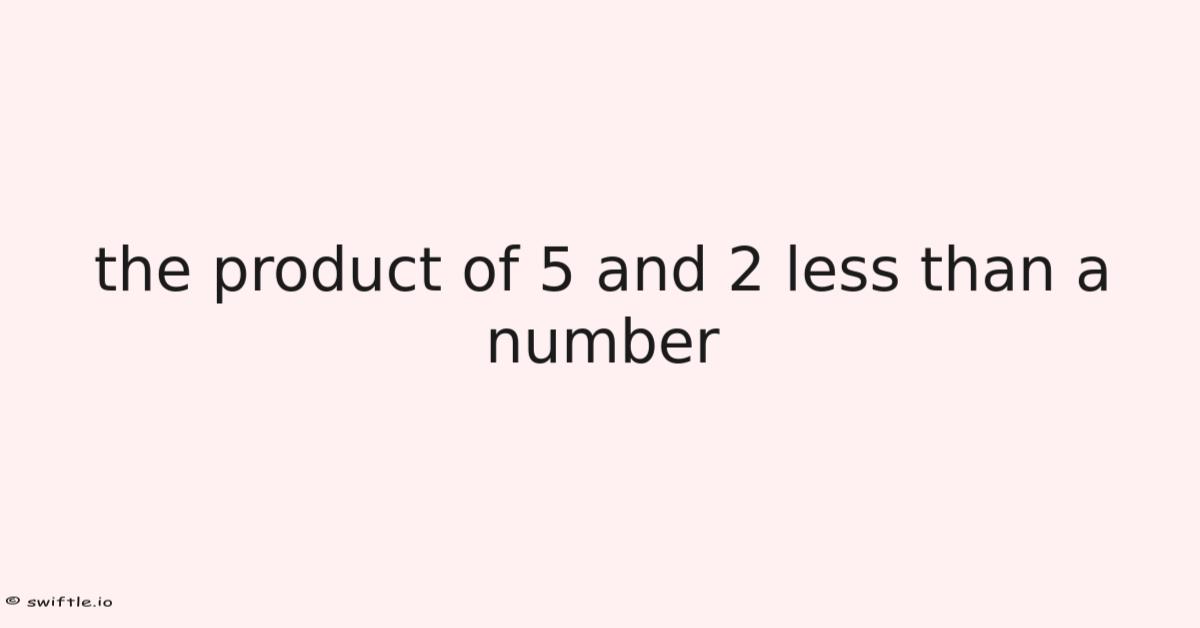
The Product of 5 and 2 Less Than a Number
Let’s start with a question: Have you ever looked at a math problem and thought, “Wait, what does this even mean?Now, phrases like “the product of 5 and 2 less than a number” sound like they’re straight out of a puzzle box, but they’re actually a pretty common way to describe relationships between numbers. ” You’re not alone. Let’s break it down.
What Is “The Product of 5 and 2 Less Than a Number”?
Okay, let’s tackle the jargon first. The word “product” in math means multiplication. So when someone says “the product of 5 and 2 less than a number,” they’re talking about multiplying 5 by something. But what’s that “something”?
Here’s the tricky part: “2 less than a number” isn’t 2. This leads to it’s the number minus 2. Still, if we call the unknown number x, then “2 less than a number” becomes x - 2*. So the full phrase translates to 5 multiplied by (x - 2*). In math terms, that’s written as 5(x - 2).
But why does this matter? In practice, because how you interpret the phrase changes the entire equation. If you read it as “5 times 2, then subtract that from a number,” you’d get x - 10*, which is totally different. So context is everything.
Why Does This Matter in Real Life?
You might be thinking
You might be thinking that this kind of phrasing only appears in textbook exercises, but the same structure shows up whenever we need to relate a quantity to a fixed offset before scaling it. Plus, consider a scenario where you’re calculating the total cost of purchasing several items that each have a discount applied before tax. Here's the thing — if each item’s base price is represented by x dollars and a store offers a flat $2 discount per item, the price you actually pay for one item is x – 2*. Buying five of those items means multiplying that discounted price by 5, giving exactly the expression 5(x – 2).
A concrete example: suppose you know the total amount spent on the five discounted items is $40. Setting up the equation 5(x – 2) = 40 lets you solve for the original price per item. Dividing both sides by 5 yields x – 2 = 8, and adding 2 to both sides gives x = 10. Basically, each item originally cost $10, the $2 discount brought the price down to $8, and five of those discounted items total $40.
The same pattern appears in physics when dealing with uniform motion. If an object travels at a constant speed v and you want to know the distance covered after it has already moved 2 units less than a certain time t, the distance formula d = v · (t – 2)* mirrors the product structure. Knowing the distance and the speed lets you back‑solve for the elapsed time, just as we did with the price example.
Even in everyday budgeting, the idea helps when you allocate a fixed amount to a group after subtracting a mandatory fee. If a club charges a $2 membership fee per member and you have a budget of $5 times the remaining amount per member for activities, the total activity fund is again 5(x – 2), where x is the per‑member allocation before the fee. Solving for x tells you how much you can originally set aside per member to stay within budget after fees.
These examples illustrate why interpreting “2 less than a number” correctly is essential: it shifts the baseline before the scaling operation, and mistaking the order leads to entirely different results. By translating verbal descriptions into algebraic expressions step by step, we turn seemingly abstract puzzles into practical tools for solving real‑world problems.
In short, recognizing that “the product of 5 and 2 less than a number” means 5(x – 2) allows us to model situations where a fixed adjustment precedes a multiplication, whether we’re shopping, traveling, budgeting, or analyzing motion. Mastering this translation bridges the gap between everyday language and quantitative reasoning, empowering us to set up and solve equations that reflect the true relationships at play.
Understanding the nuance of “2 less than a number” also helps when the adjustment is not a simple subtraction but a more complex transformation. Suppose a tax‑exempt coupon reduces the price of each item by 15 % before a bulk discount of 5 % is applied. Here the percentage reduction acts like a multiplicative “less than” operation, and the overall effect can still be expressed as a product of a constant and a modified variable. 85x) = 0.That's why 8075x. If the original price is x, the coupon first yields 0.Think about it: 95·(0. 85x, and the subsequent bulk discount gives 0.Recognizing that the modifier (whether additive or multiplicative) must be applied before the outer scaling prevents errors such as mistakenly writing 5x – 2 instead of 5(x – 2), which would imply the discount is taken after the total has been summed — a situation that only arises when the discount is applied to the entire purchase, not to each individual item.
A quick way to verify the correct ordering is to test the expression with a concrete value. Day to day, plugging x = 12 into 5x – 2 gives 58, which clearly does not match the intended scenario. Consider this: if we guess x = 12, then “2 less than a number” is 10, and five times that is 50. This simple check catches the common slip of reversing the order of operations.
Extending the idea, the same principle appears in formulas for compound interest where a fixed fee is deducted before interest accrues: the balance after one period might be P – f, then multiplied by (1 + r). Writing the fee after the interest factor would misrepresent the timing of the deduction and lead to inaccurate forecasts.
By consistently translating verbal phrases into algebraic form — identifying the core variable, applying any stated adjustments first, and then attaching any scaling factors — we build a reliable bridge between everyday language and precise mathematical modeling. This habit not only solves the immediate problem at hand but also cultivates a systematic approach to tackling more detailed, multi‑step word problems across disciplines.
In short, mastering the translation of “2 less than a number” into the expression (x – 2) and recognizing that any subsequent multiplication must act on that adjusted quantity enables accurate modeling of real‑world situations where a fixed change precedes a proportional scaling. Practicing this translation sharpens quantitative reasoning and prevents the subtle yet consequential errors that arise from misordering operations.
Extending the Principle to More Complex Scenarios
The “adjust‑then‑scale” mindset proves especially valuable when problems involve multiple layers of transformation. Consider a scenario where a retailer offers a $10 rebate on each unit, then applies a 20 % seasonal markup, and finally adds a flat shipping fee of $3 per order. If the base price of an item is p, the correct algebraic flow is:
- Apply the rebate: (p - 10)
- Apply the markup: (1.20,(p - 10) = 1.20p - 12)
- Add the shipping fee: ((1.20p - 12) + 3 = 1.20p - 9)
A common misstep is to add the shipping fee before the markup, yielding (1.On top of that, 20,(p - 10 + 3) = 1. 20p - 8.Which means 4). The $0.60 discrepancy may seem trivial, but in high‑volume transactions it can materially affect profit margins and pricing strategies.
Another illustration comes from pharmacology, where a drug dosage is calculated as a percentage of a patient’s body weight after subtracting a fixed “loading dose.” If a patient weighs w kilograms and the loading dose is 5 mg, the remaining dose is (0.Which means 04,(w - 5)) mg (assuming a 4 % per‑kg regimen). Placing the percentage before the subtraction would over‑estimate exposure, a potentially dangerous error.
A Systematic Checklist for Word‑Problem Translation
To avoid order‑of‑operations pitfalls, adopt a three‑step checklist:
- Identify the core variable (e.g., x, p, w).
- List every verbal adjustment in the order they occur (e.g., “2 less than a number,” “15 % discount,” “$10 rebate”).
- Apply adjustments sequentially, using parentheses to lock in each step before moving to the next scaling factor.
When the problem statement includes phrases like “k times the result of …”, the scaling factor should be attached to the already‑adjusted expression, not to the original variable.
Want to learn more? We recommend how many days are in 6 weeks and how many grams to a quarter pound for further reading.
Real‑World Verification Techniques
Beyond plugging in a single concrete value, you can perform sensitivity analysis: evaluate the expression at two distinct points and compare the outcomes with the expected behavior described in the problem. And for instance, if a discount is applied before a markup, the final price should increase less dramatically with the base price than if the markup were applied first. Demonstrating this relationship with a quick spreadsheet or a mental estimate reinforces confidence in the algebraic model.
Looking Ahead: Building a Toolbox of Translations
Mastering the translation of simple phrases like “2 less than a number” is only the first rung on a ladder that leads to sophisticated modeling in fields such as economics, engineering, and data science. The same principle underlies:
- Compound interest formulas with periodic fees.
- Physics equations where a constant offset precedes a proportional factor (e.g., temperature conversion).
- Computer algorithms that apply conditional adjustments before scaling operations.
By internalizing the “adjust‑then‑scale” pattern, you equip yourself with a versatile heuristic that transcends any single discipline. It becomes a mental shortcut that automatically flags when a phrase demands parentheses around a subtraction or percentage before a multiplication.
To keep it short, the ability to render everyday language into precise algebraic form—recognizing that any fixed change must be applied before subsequent scaling—serves as a cornerstone of accurate quantitative reasoning. Consistently practicing this translation not only resolves immediate word‑problems but also cultivates a disciplined approach to the multi‑step calculations that arise in advanced studies and professional practice. Mastering this skill empowers you to model real‑world situations confidently, avoid costly ordering errors, and build a reliable foundation for future mathematical challenges.
To further refine your approach to translating verbal descriptions into algebraic expressions, consider the following strategic steps and examples that illustrate the importance of precision and attention to detail:
Strategic Steps for Translation
-
Identify the Core Variable: Begin by pinpointing the unknown quantity (e.g., a number, price, or measurement) represented by a variable like x, p, or w. This forms the foundation of your equation.
-
List Verbal Adjustments in Sequence: Break down the problem into individual operations. For instance:
- "5 more than a number" → +5
- "30% off the original price" → ×0.7
- "a $20 rebate" → −20
- "twice the discounted amount" → ×2
-
Apply Adjustments in the Correct Order: Use parentheses to ensure operations are grouped logically. For example:
- "A $20 rebate followed by a 30% discount" → 0.7(p − 20) (subtract first, then scale).
- "30% off, then a $20 rebate" → 0.7p − 20 (scale first, then subtract).
-
Verify with Sensitivity Analysis: Test your expression with multiple values to confirm it behaves as expected. Take this case: if a markup of 10% is applied before a $5 discount, the final price should increase more steeply with the base price than if the discount were applied first.
Real-World Examples
-
Economics:
A company offers a 15% discount followed by a $10 rebate. The final price for an item costing p dollars is:
$ 0.85p - 10 $
If the rebate were applied first, the expression would be:
$ 0.85(p - 10) $
These differ significantly, highlighting the importance of order. -
Physics:
Temperature conversion from Fahrenheit to Celsius involves a fixed offset and a scaling factor:
$ C = \frac{5}{9}(F - 32) $
Here, the subtraction (F − 32*) is applied before scaling by $\frac{5}{9}$, reflecting the real-world process. -
Computer Science:
An algorithm applies a 20% reduction to a dataset size n, then multiplies it by 3:
$ 3(n \times 0.8) = 2.4n $
Reversing the order (scaling first) would yield $3n \times 0.8 = 2.4n$, but this is coincidental. In most cases, order matters (e.g., $3(n + 5) \neq 3n + 5$).
Advanced Applications
-
Compound Interest with Fees:
If a bank charges a $50 fee annually and applies a 3% interest rate, the balance A after one year for an initial deposit P is:
$ A = 1.03P - 50 $
This models real-world financial scenarios where fixed costs precede proportional growth. -
Engineering Design:
A beam’s deflection d under load L might follow:
$ d = k(L - 10) $
Here, a baseline load of 10 units is subtracted before applying the proportionality constant k.
Conclusion
Mastering the translation of verbal phrases into algebraic expressions is not merely an academic exercise—it is a critical skill for modeling real-world systems. Whether calculating discounts, designing engineering solutions, or analyzing data, the ability to apply adjustments in the correct sequence ensures accuracy and reliability. By consistently practicing this "adjust-then-scale" pattern, you develop a disciplined mindset that prevents errors and fosters confidence in tackling complex problems. This foundational skill empowers you to manage the nuances of quantitative reasoning, bridging the gap between abstract mathematics and practical application. As you advance, remember that precision in translation is the key to unlocking deeper insights and solving multifaceted challenges across disciplines.
