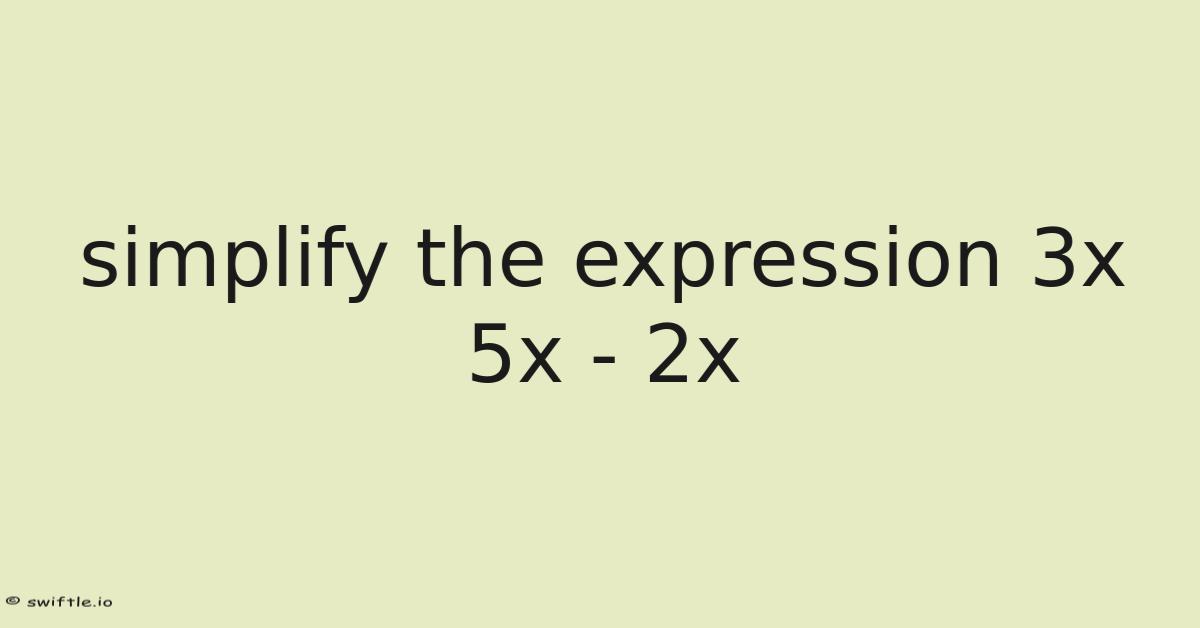
Ever stared at 3x 5x - 2x and wondered if you were looking at a secret code instead of a simple algebraic expression?
You’re not alone. Most of us have taken a quick glance at a string of letters and numbers, shrugged, and moved on—only to realize later that the “quick glance” actually hid a tiny, but useful, math shortcut.
The good news? In real terms, untangling that little mess takes just a few minutes and a sprinkle of common‑sense. By the end of this post you’ll be able to walk away confident that you can simplify any similar expression without breaking a sweat.
What Is Simplifying an Algebraic Expression?
When we talk about “simplifying,” we’re not looking for a fancy new form of the equation. We just want the most compact, easy‑to‑read version that still means exactly the same thing.
In the case of 3x 5x - 2x, the expression is a sum of three terms that all share the same variable, x. The numbers in front of the x’s—called coefficients—are what we can combine. On the flip side, think of it as gathering all the apples in a basket: if you have 3 apples, 5 more apples, and then you take away 2 apples, how many are left? Now, the answer is 6 apples. The algebraic version works the same way.
The Building Blocks
- Term – a single piece of an expression, like
3xor-2x. - Coefficient – the number sitting in front of the variable (3, 5, -2).
- Like terms – terms that have the exact same variable raised to the same power. Here, all three are just
x, so they’re “like.”
When you have like terms, you can add or subtract their coefficients and keep the variable unchanged.
Why It Matters / Why People Care
You might ask, “Why bother simplifying something so tiny?”
First, speed. Practically speaking, in a test or a real‑world problem, you’ll often need to plug numbers in later. A tidy expression reduces the chance of a slip‑up.
Second, clarity. When you’re juggling several equations, a clean version lets you see relationships at a glance. It’s the difference between a cluttered desk and a neat workspace—both hold the same stuff, but one feels a lot easier to work with.
Third, foundation. Simplifying is the first step toward solving equations, factoring, or even graphing. Miss this step, and you’ll carry extra baggage through the rest of the problem, which can lead to mistakes down the line.
How to Simplify 3x 5x - 2x
Below is the step‑by‑step process that works for any collection of like terms. Grab a pen, follow along, and you’ll see why it’s almost automatic after a couple of tries.
1. Identify the Like Terms
Look at each piece:
3x→ coefficient 35x→ coefficient 5-2x→ coefficient -2
All three share the variable x, so they’re like terms.
2. Separate the Coefficients
Write the coefficients in a row, ignoring the variable for a moment:
3 + 5 - 2
Notice the minus sign in front of 2x becomes a minus sign before the 2.
3. Perform the Arithmetic
Add and subtract the numbers just as you would in a regular math problem:
3 + 5 = 88 - 2 = 6
So the combined coefficient is 6.
4. Reattach the Variable
Now stick the variable back onto the new coefficient:
6x
That’s it—3x 5x - 2x simplifies to 6x.
Common Mistakes / What Most People Get Wrong
Even seasoned students trip up on the same pitfalls. Spotting them early can save you a lot of frustration.
| Mistake | Why It Happens | How to Avoid It |
|---|---|---|
Treating 3x 5x as multiplication |
The lack of a plus sign makes the eyes wander. g. | Write the arithmetic line out explicitly (3 + 5 - 2) before calculating. On top of that, seeing the plus sign helps keep the minus visible. |
| Dropping the negative sign | The minus sign can blend into the surrounding text. , 3x·5x), the result would be 15x², a completely different beast. |
|
| Combining coefficients incorrectly | Adding 3 + 5 + 2 = 10 instead of 3 + 5 - 2. If you do see multiplication (e.That's why | Write the expression with clear spacing: 3x + 5x - 2x. Even so, |
| Leaving the variable out | After crunching the numbers, some forget to put the x back. |
Always end the process with a quick “attach variable” check. |
Practical Tips / What Actually Works
-
Add Space, Add Clarity – When you first copy an expression, insert spaces around each term and each operator.
3x + 5x - 2xis instantly easier to read than3x5x-2x. -
Use a Scratch Line – Write the coefficients on a separate line, do the arithmetic, then rewrite the final term. This habit prevents you from mixing up signs.
-
Check with Substitution – Plug a simple number for
x(like 1) into the original and simplified expressions. If both give the same result, you’ve likely done it right. -
Teach It to Someone Else – Explaining the steps out loud forces you to own the process. Even a quick chat with a friend or a rubber‑duck can cement the method.
-
Create a One‑Sentence Cheat Sheet – “Combine like terms by adding/subtracting coefficients, then re‑attach the variable.” Keep it on a sticky note near your study space.
FAQ
Q: What if the expression had different powers, like 3x² + 5x - 2x?
A: Only terms with the exact same variable and exponent are like terms. Here, 3x² stands alone, while 5x and -2x combine to 3x. The simplified form would be 3x² + 3x.
Q: Does the order of terms matter when simplifying?
A: No. 5x + 3x - 2x simplifies the same way as 3x - 2x + 5x. Algebra is commutative for addition and subtraction.
Q: How do I know if there’s an implicit multiplication, like 3x5x?
A: If the problem is from a basic algebra worksheet, it’s almost always meant to be addition unless a multiplication sign or parentheses are shown. When in doubt, ask the source or look for context clues.
Q: Can I use a calculator for this?
A: Sure, but the mental step is quick enough that a calculator is overkill. Plus, doing it by hand reinforces the concept for future, more complex problems.
Q: What if the coefficients are fractions?
A: Same rule applies. For ½x + ⅓x - ¼x, find a common denominator (12), convert: 6/12x + 4/12x - 3/12x = 7/12x. The variable stays attached.
Simplifying 3x 5x - 2x isn’t a magic trick; it’s just a tiny bit of tidy‑up that pays off every time you see a string of like terms. Next time you spot a similar expression, you’ll know exactly what to do—no second‑guessing, no unnecessary steps.
And that’s the short version: grab the coefficients, do the math, stick the variable back on, and you’re done. Happy simplifying!
A Few More Edge‑Case Scenarios
Even after you’ve mastered the “add the coefficients and re‑attach the variable” routine, you’ll occasionally run into expressions that look similar but hide a subtle twist. Below are some of the most common variations and how to handle them without tripping up.
| Situation | Why It Trips You Up | Quick Fix |
|---|---|---|
Hidden parentheses – 3x(5x‑2x) |
The parentheses force a multiplication before you even think about like terms. Also, | Distribute first: 3x·5x = 15x² and 3x·‑2x = ‑6x². Plus, |
Higher‑order terms that look alike – 3x² + 5x – 2x² |
The exponents differ, so they’re not “like”. Because of that, | Write the sign explicitly: (-3)x + 5x – 2x = (‑3 + 5 – 2)x = 0x. |
Implicit multiplication without a sign – 3x5x (no plus/minus) |
Some textbooks use juxtaposition to indicate multiplication, not addition. Here's the thing — | Interpret as 3x·5x = 15x². The whole expression collapses to 0. |
Mixed signs with a leading minus – ‑3x + 5x – 2x |
A leading negative can make you forget to treat it as “‑3x”. In real terms, | Combine only the x² terms: (3x² – 2x²) + 5x = 1x² + 5x. Then combine: 15x²‑6x² = 9x². Worth adding: |
Variables with different letters – 3x + 5y – 2x |
Only terms with the same* letter combine. If the problem explicitly says “simplify the sum”, you’ll see a plus sign somewhere; otherwise, treat it as a product. |
The “Zero‑Coefficient” Surprise
When the sum of the coefficients turns out to be zero, the variable disappears entirely:
If you found this helpful, you might also enjoy how many minutes in a week or how many years is a score.
7x – 4x – 3x = (7 – 4 – 3)x = 0x = 0
That 0 is a perfectly valid, simplified result. It’s easy to overlook, especially when you’re used to seeing a variable at the end of every answer. Remember: If the coefficient is zero, the term vanishes.
When to Pause and Verify
Even seasoned algebraists double‑check their work. Here are two fast verification tricks that cost seconds but save points on a test:
- Reverse‑Engineer – After you’ve simplified, expand the result back out. If you get the original expression, you’re golden.
- Plug‑In a Test Value – Choose
x = 2(orx = -1for a sign check). Compute both the original and simplified expressions; they should match.
Bridging to the Next Level
Now that you can clean up linear expressions in a flash, you’re ready to tackle the next set of algebraic tools that rely on the same principle:
- Factoring – Pull a common factor (often a variable) out of a sum:
3x + 6x = 3x(1 + 2) = 3x·3 = 9x. Recognizing the combined coefficient first makes factoring intuitive. - Solving Simple Equations – When an equation contains several like terms on one side, combine them first, then isolate the variable:
3x + 5x – 2x = 12→6x = 12→x = 2. - Polynomial Addition/Subtraction – Adding two polynomials is just a series of “combine like terms” steps, applied term‑by‑term.
Each of these topics leans on the same mental habit: extract the coefficients, do the arithmetic, then re‑attach the variable (or variables) exactly as they appeared. Practicing this habit now builds a sturdy foundation for the algebraic manipulations you’ll encounter later in high school, college, or any STEM‑related field.
Final Thoughts
Simplifying an expression like 3x 5x ‑ 2x may look like a tiny footnote in the grand textbook of algebra, but the discipline it teaches is anything but minor. By:
- Visually separating the numbers from the variable,
- Adding/subtracting the coefficients with care, and
- Re‑uniting the variable only after the arithmetic is settled,
you develop a repeatable workflow that eliminates careless errors and boosts confidence. The extra seconds you spend inserting spaces, writing a quick scratch line, or doing a substitution check pay off in cleaner work, higher grades, and a deeper intuition for how algebraic structures behave.
So the next time you encounter a string of terms—whether it’s 7a – 3a + 2a, ½x + ⅓x – ¼x, or a more elaborate polynomial—remember the three‑step mantra:
Coefficients → Compute → Variable.
Apply it, and you’ll find that what once felt like a puzzling scramble turns into a smooth, almost automatic, mental routine. Happy simplifying, and may your algebra always stay tidy!
From Paper to Practice: Quick‑Fire Drills
To cement the three‑step mantra, try a few “one‑minute drills” before you head into class or sit down for homework. Set a timer for 60 seconds, grab a sheet of scrap paper, and race through these:
| # | Expression | Simplified |
|---|---|---|
| 1 | 4y + 9y – 5y |
8y |
| 2 | 12m – 7m + 3m – 2m |
6m |
| 3 | ½z + ⅔z – ¼z |
11/12 z |
| 4 | -3p + 8p - p |
4p |
| 5 | 0.6t + 1.4t |
2t |
If you finish early, double‑check by plugging in a value (say, t = 5). The speed‑up isn’t magic; it’s the result of muscle memory built from repetitive, focused practice.
When the Variable Isn’t Alone
In many problems the variable appears with an exponent or a subscript, e.g., 5x² + 3x². The same rules apply—just treat the whole* term x² as the “unit” you’re pulling out.
5x² + 3x² = (5 + 3)x² = 8x²
Even when the term includes a coefficient inside a fraction, such as (7/3)k³ – (2/3)k³, you can combine the numerators first:
(7/3 – 2/3)k³ = (5/3)k³
The takeaway: as long as the variable part (including any exponent, subscript, or attached function) matches exactly, you can combine the front‑end numbers. If the variable parts differ—x vs. x², a₁ vs. a₂—they are not like terms and must stay separate.
Common Pitfalls and How to Dodge Them
| Pitfall | Why It Happens | Fix |
|---|---|---|
| Dropping a sign (e.Practically speaking, | ||
Mixing unlike terms (adding 2x and 3y) |
Over‑reliance on “look‑like‑terms” heuristics | Highlight the variable part (the “x‑part”) in a different colour; only terms sharing that colour get combined. g., turning -4x into +4x) |
Forgetting parentheses in expressions like 3(x + 2) – 5x |
The distributive step is skipped | Expand first: 3x + 6 – 5x = (3 – 5)x + 6 = -2x + 6. |
Mis‑handling fractions (adding 1/2x and 1/3x) |
Assuming you can add denominators directly | Find a common denominator: 1/2x + 1/3x = (3/6 + 2/6)x = 5/6x. |
A quick “mental checklist” before you finish a problem can catch most of these:
- Identify the variable part of each term.
- Write the coefficient with its sign clearly.
- Add/subtract the coefficients only after they share a common denominator (if needed).
- Re‑attach the variable part exactly as it appeared.
Extending the Skill: Real‑World Contexts
Algebra isn’t confined to textbook drills; it surfaces in everyday calculations:
- Budgeting: If your monthly phone bill is
$30 + $5xwherexis the number of extra data packs, and you add a fixed service fee of$15, the total becomes($30 + $15) + $5x = $45 + 5x. The constant dollars combine, leaving the variable cost untouched. - Physics: A distance formula
d = vt + (1/2)at²often requires grouping the terms that share the same time exponent. If you have3t + 4t – (1/2)t, you first combine the lineartterms:(3 + 4 – 0.5)t = 6.5t. - Engineering: When calculating total resistance in parallel circuits, you might encounter
1/R = 1/4Ω + 1/6Ω. Though this isn’t a “like‑term” situation, the habit of isolating the numeric part before recombining (here, taking a common denominator) mirrors the same disciplined approach.
Seeing the pattern across domains reinforces why the three‑step routine is worth mastering—it’s a universal algebraic “tool belt” you’ll reach for again and again.
A Mini‑Project: Build Your Own “Combine‑Like‑Terms” Cheat Sheet
- Create a table of common variable patterns you encounter (e.g.,
x,x²,xy,a₁,sinθ). - Leave a blank column beside each for the combined coefficient.
- Fill it in as you practice, using the steps above. Over a week you’ll have a personalized reference that makes spotting like terms almost automatic.
Conclusion
Simplifying expressions such as 3x 5x ‑ 2x may feel like a modest exercise, but it encapsulates a core algebraic habit: separate the numeric scaffolding from the symbolic structure, perform the arithmetic, then re‑assemble the expression with precision. By consistently applying this habit you:
- Eliminate careless sign and coefficient errors.
- Gain speed on tests and homework.
- Build a mental framework that scales to factoring, solving equations, polynomial operations, and even real‑world problem solving.
Remember the mantra—Coefficients → Compute → Variable—and let it guide every algebraic manipulation you meet. With a few minutes of focused practice each day, the process will become second nature, freeing up mental bandwidth for the more nuanced challenges that lie ahead. Happy simplifying, and may your future algebra always stay tidy and transparent.
