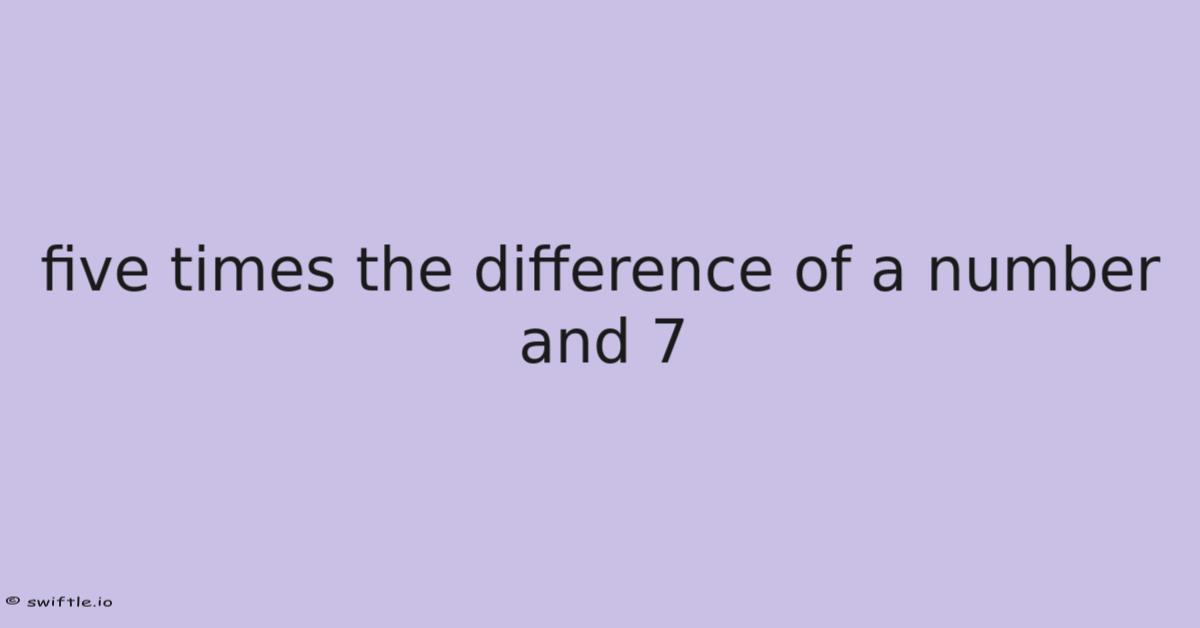
Five Times the Difference of a Number and 7: Why This Simple Expression Matters More Than You Think
Let’s start with a question that might seem basic but trips up more people than you’d expect: What happens when you take a number, subtract seven from it, and then multiply the result by five? Sounds straightforward, right? But here’s the thing — this little expression, five times the difference of a number and 7*, is a gateway to understanding how algebra works in real life.
You’ve probably seen something like this in math class. So naturally, maybe you thought, “When am I ever going to use this? ” Well, stick around. Because whether you’re calculating profit margins, adjusting recipes, or figuring out how much paint you need for a wall, expressions like this show up everywhere.
What Is Five Times the Difference of a Number and 7?
At its core, this phrase describes an algebraic expression. In math terms, we write it as:
5(x – 7)
Or, if we want to spell it out: five multiplied by the quantity of (x minus seven)*. Here, x is just a placeholder for any number you choose. Day to day, the “difference” part means subtraction, and the “five times” part means multiplication. So, you do the subtraction first, then multiply the result by five.
But hold on — let’s not get lost in symbols yet. But think of it like this: imagine you’re running a small business. Your product costs $7 to make, and you sell it for five times that cost. How would you write that? You’d take the cost (let’s call it x), subtract the base cost ($7), then multiply by five. That gives you your markup.
This kind of thinking isn’t just for math class. It’s for life.
Breaking Down the Components
Let’s unpack the expression piece by piece:
- The number (x): This is your starting value. It could be anything — 10, 20, 100.
- The difference (x – 7): This is where you subtract 7 from your chosen number. The order matters here. It’s not 7 minus x.
- Five times: Once you have that difference, you multiply it by 5.
So if x is 12, the difference is 12 – 7 = 5. Then five times that difference is 5 × 5 = 25.
Simple enough? Maybe. But let’s dig deeper.
Why It Matters: Real Talk About Algebraic Thinking
Here’s the deal. When you understand expressions like 5(x – 7), you’re building a foundation for problem-solving. Not just in math, but in logic, finance, engineering, and even everyday decisions.
Take a real-world example: You’re planning a road trip and want to budget for gas. So you know your car uses about 7 gallons per day on average. If you plan to drive for x days, how much will you spend if gas costs $5 per gallon?
You’d calculate: 5(x – 7). And wait, that doesn’t make sense. Let me correct that. Actually, you’d calculate 5 × (7x) or maybe 5 × 7 × x, depending on the context. But the point is, breaking down problems into parts — like identifying the difference first, then scaling it — is a skill that translates across fields.
And here’s where things go sideways for a lot of people. That’s not how it works. The order of operations matters. That's why they see an expression like 5(x – 7) and immediately try to multiply 5 by x, then subtract 7. The parentheses matter. And skipping steps leads to mistakes.
I’ve seen students — and adults — mess this up in spreadsheets, in budgeting apps, in DIY projects. They treat math like a race instead of a process. But when you slow down and respect the structure of an expression, the answers come easier.
How It Works: Step-by-Step Breakdown
Let’s walk through how to evaluate 5(x – 7) with a few examples. This is where the rubber meets the road.
Step 1: Identify the Variable
Pick a value for x. Let’s say x = 15.
Step 2: Calculate the Difference
Subtract 7 from x: 15 – 7 = 8
Want to learn more? We recommend 20 weeks is how many months and how many months is 100 days for further reading.
Step 3: Multiply by Five
Take that result and multiply by 5: 5 × 8 = 40
So, 5(15 – 7) = 40.
Easy, right? Now try x = 3.3 – 7 = -4
5 × (-4) = -20
So, 5(3 – 7) = -20.
Negative numbers can trip people up. But the process stays the same.
Step 4: Check Your Work
Plug the numbers back in. If you’re subtracting more than you started with, you should expect a negative result. Does the answer make sense? That’s normal.
Step 5: Apply to Word Problems
Let’s say a gym membership costs $7 to sign up, plus $5 per month. If Maria has been a member for x months, how much has she paid in total?
Her total cost would be 7 + 5x. But if the question was, “How much has she paid in monthly fees beyond the first month?” then it’s 5(x – 1). See how the structure changes based on the scenario?
Understanding these nuances saves headaches later.
Common Mistakes People Make
Let’s be honest. And most people rush through expressions like this. And that’s where errors creep in.
Mistake #1: Ignoring the Parentheses
Some folks see 5(x – 7) and think it’s 5x – 7. The parentheses mean you do the subtraction first. That’s wrong. Always.
Mistake #2: Forgetting the Order of Operations
Even if you remember the parentheses, you might still mess up the sequence. Multiplication and division come after addition and subtraction in PEMDAS — but only when they’re not inside parentheses. Inside the parentheses, subtraction happens first.
Mistake #3: Misapplying Negative Numbers
If x is less than 7, the difference becomes negative. Some people panic here. Because of that, multiply that by 5, and you get a negative result. But negative numbers are just as valid as positive ones.
Mistake #4: Not Checking the Context
In word problems, misreading the question leads to wrong setups. Is the difference between the number
and 7 relevant? On the flip side, is the expression part of a larger equation? In practice, skipping these clarifications leads to answers that technically solve the math but fail to address the actual problem. Take this case: calculating 5(x – 7) when x = 10 gives 15, but if the scenario involves a debt or deficit, that positive result might be misleading. Context anchors the numbers in reality.
The Bigger Picture
Expressions like 5(x – 7) aren’t just abstract puzzles. They model real-world relationships: discounts, growth rates, financial projections. The parentheses act as a lens, focusing attention on the critical relationship between variables. Ignoring them distorts the model. As an example, a salesperson earning $5 per sale but losing $7 for each canceled appointment would have net earnings of 5x – 7. But if the $7 penalty applies only after 7 cancellations, the expression becomes 5x – 7(x – 7), which simplifies to 5x – 7x + 49 = -2x + 49. Here, parentheses shift the entire interpretation.
Why This Matters
Math isn’t about speed; it’s about precision. Every symbol has a purpose. Parentheses group ideas, order of operations defines logic, and variables represent unknowns. Skipping steps or misinterpreting symbols doesn’t just yield wrong answers—it perpetuates confusion. A student who rushes through 5(x – 7) might later struggle with compound interest formulas or physics equations, where layered operations are unavoidable.
Final Thought
The next time you face an expression like 5(x – 7), pause. Ask: What’s inside the parentheses first?* How does that shape the rest of the calculation?* Respect the process. Math rewards patience. Whether you’re balancing a checkbook or designing a bridge, the rules don’t bend—and neither should your approach. Master the steps, and the answers will follow. Naturally.
