Ever sat staring at a math problem that felt like it was designed specifically to annoy you? You know the type. It’s sitting there on a worksheet, or maybe it’s part of a budget you’re trying to balance, or perhaps it's a tip you're trying to calculate at a restaurant.
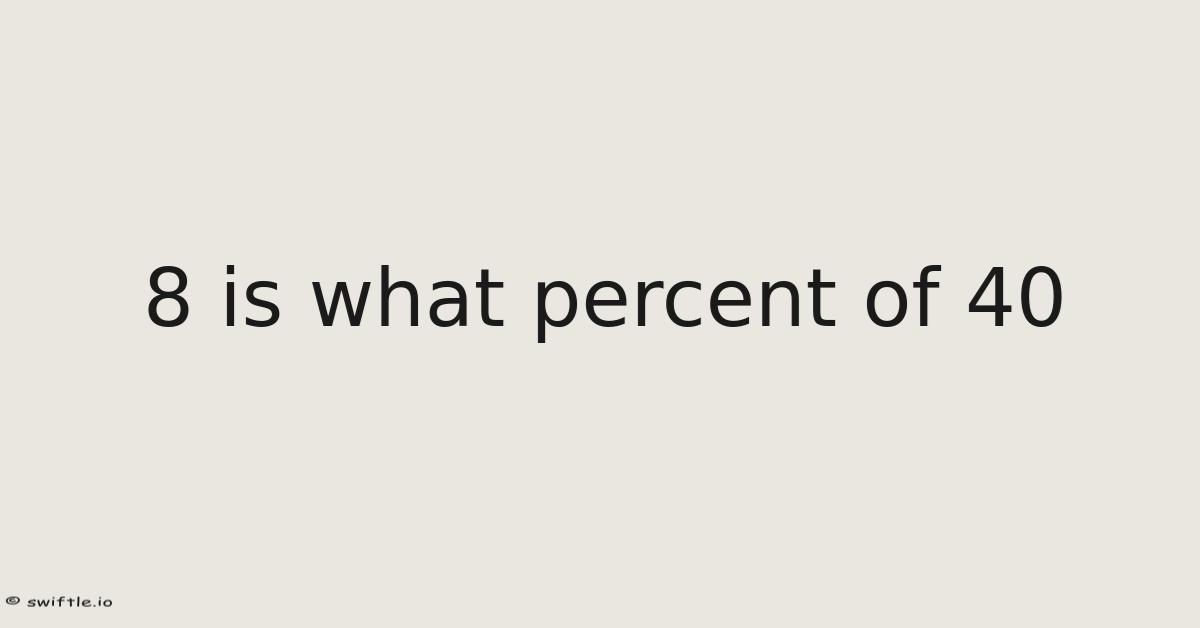
8 is what percent of 40?
It sounds simple. It really does. But unless you have a calculator glued to your hand, your brain might decide to take a sudden, unannounced vacation right when you need it most.
What Is This Math Problem Actually Asking?
When we talk about finding a percentage, we aren't doing anything mystical. We are just trying to figure out how a small part relates to a whole.
Think of it like this: imagine you have a box of 40 donuts. In real terms, you look inside and see there are only 8 left. You want to know how much of your stash is gone. You're looking for that specific slice of the pie.
The Concept of "Percent"
The word percent* literally means "per hundred." If you had 100 donuts and 8 were gone, that would be 8%. But since we only have 40, the "slice" is going to be much larger. We are trying to scale that number 8 up to a scale of 100 so we can understand its weight relative to the total.
The Relationship Between Parts and Wholes
In math terms, the 8 is our part* and the 40 is our whole*. Whenever you see a question phrased as "X is what percent of Y," you are essentially looking for the ratio between those two numbers, expressed as a percentage. It’s a comparison. It’s asking, "How big is this piece compared to the entire thing?"
Why It Matters (And Why You Keep Getting Stuck)
You might be thinking, "I'll just use a calculator, why do I need to understand the logic?"
Here’s the thing — calculators are great until you don't have one. In real terms, or, even worse, until you type the wrong numbers into one. If you don't understand the underlying logic of how parts relate to wholes, you won't catch the error when the calculator tells you something nonsensical.
Understanding these ratios is vital in real life. It shows up in:
- Finance: If you have $40 and you spend $8, what percentage of your money did you just blow on coffee?
- Statistics: If 8 out of 40 people in a survey answered "yes," how much of the group actually agrees?
- Cooking and Chemistry: If a recipe calls for 40g of flour and you only have 8g, how much of the required amount do you actually have?
When you can't do this mental math, you lose a bit of control over the numbers around you. You become a passenger to the math rather than the driver.
How to Solve It (The Right Way)
A few ways exist — each with its own place. Consider this: i'll show you the "math class" way, the "shortcut" way, and the "visual" way. Depending on how your brain works, one of these will click much faster than the others.
The Standard Formula Method
This is the reliable, "never-fail" method. If you can remember this one simple formula, you can solve any percentage problem ever thrown at you.
The formula is: (Part / Whole) × 100 = Percentage
Let's plug our numbers in:
- Divide it by the whole: 40 3.Which means take the part: 8
- 8 divided by 40 is 0.2
That’s it. But 8 is 20% of 40. It’s clean, it’s logical, and it works every single time.
The Fraction Simplification Method
If you hate long division, you might prefer working with fractions. This is often faster if you are good at simplifying numbers in your head.
First, write the relationship as a fraction: 8/40
Now, simplify that fraction. Both 8 and 40 can be divided by 8.
- 8 ÷ 8 = 1
- 40 ÷ 8 = 5
So, 8/40 is the same as 1/5.
Now, ask yourself: what is 1/5 as a percentage? Since 1/5 is the same as 0.2, and 0.In real terms, 2 is 20%, you have your answer. This method is great because it turns a scary division problem into a simple fraction problem.
The "Scale Up" Method (Mental Math)
This is how I do it when I'm out at a restaurant or shopping. I look for "friendly numbers."
We know that 40 is a very easy number to work with because it’s just 10 times 4. Also, if we want to find 10% of 40, we just move the decimal one spot to the left. 10% of 40 is 4.
Now, look at our original number: 8. Now, if 4 is 10% of 40, then 8 must be... 20%.
At its core, the fastest way to do it in your head. You find 10% first, and then you just double it or triple it until you hit your target number.
Common Mistakes / What Most People Get Wrong
I’ve seen people trip up on this a thousand times. Usually, it’s not because they can't do the math, but because they are misinterpreting the question.
If you found this helpful, you might also enjoy how many inches is 28 cm or how many rolls are in dimes.
Reversing the Numbers
This is the most common error. Someone sees 8 and 40 and accidentally calculates "What percent of 8 is 40?"
If you do that, you get 500%. Worth adding: while that is a valid math question, it is not the answer to the question we are asking. Even so, always remember: the "whole" (the larger number, usually) goes on the bottom of your fraction. The "part" goes on top.
Forgetting to Multiply by 100
People often do the division (8 ÷ 40 = 0.2) and then stop. They say, "The answer is 0.2."
But 0.Because of that, 2 isn't a percentage; it's a decimal. You have to multiply by 100 to shift that decimal point and turn it into a percentage. 0.2 becomes 20%. It sounds like a small distinction, but in a business meeting, saying "we are at 0.2 percent" when you mean "20 percent" is a massive difference.
Confusing "Percent" with "Percentage Points"
This is a more advanced mistake, but it's worth knowing. If a bank says their interest rate went from 10% to 12%, they didn't increase it by 2 percent. They increased it by 2 percentage points*. That's a 20% increase in the actual rate. It’s a nuance, but if you're dealing with money, these nuances are everything.
Practical Tips / What Actually Works
If you want to get fast at this, stop relying on your phone for every little calculation. Here is how you actually build that "math muscle."
- Learn your 10% rule. This is the single most useful mental math trick. To find 10% of any number, just move the decimal one place to the left. 10% of 500 is 50.10% of 85 is 8.5. Once you have 10%, you can find 20% (double it), 5% (half of 10%), or 1% (move the decimal two places).
- Visualize the "Whole." When you see a problem, visualize a bar or a circle. If the bar is 40 units long and you shade in 8, you can visually see that you've shaded in about
Visualize the “Whole” – Turning Abstract Numbers into Concrete Images
When you picture a bar that’s 40 units long and then shade a section that measures 8 units, the brain instantly registers that the shaded portion is roughly one‑fifth of the whole. That visual cue tells you that the fraction is 8⁄40 = 0.20, which translates to 20 %.
The same technique works with circles, pies, or even everyday objects. Imagine a pizza cut into 10 equal slices. If you eat 2 slices, you’ve consumed 20 % of the pizza. If the pizza were split into 5 slices instead, each slice would represent 20 % as well—showing how the “whole” defines the percent value.
Building a Mental Library of Benchmarks
Instead of calculating each time from scratch, train yourself to recognize a handful of go‑to benchmarks:
| Benchmark | How to Recall |
|---|---|
| 1 % | Move the decimal two places left (e.g., 1 % of 73 → 0.73) |
| 5 % | Half of 10 % (e.Because of that, g. , 5 % of 73 → 3.65) |
| 10 % | Move the decimal one place left (e.In practice, g. , 10 % of 73 → 7. |
When you need 18 % of a number, for instance, you can think “10 % + 5 % + 3 % (which is roughly half of 5 %)”. This layered approach lets you assemble the answer quickly without a calculator.
Real‑World Scenarios Where Speed Matters
- Shopping: Spotting a “30 % off” tag means you only pay 70 % of the original price. If an item costs $45, you can quickly estimate the discount: 10 % of $45 = $4.50, so 30 % ≈ $13.50 off, leaving about $31.50.
- Budgeting: If you allocate 15 % of a $2,000 monthly income to savings, 10 % is $200, 5 % is $100, so 15 % = $300.
- Business Metrics: A growth rate that moves from 4 % to 6 % is a 50 % increase in the rate (not a 2 % rise). Recognizing the distinction prevents miscommunication in reports.
Turning Theory into Habit
- Practice with Everyday Numbers – Pick a receipt, a bill, or a news headline and estimate the percentages without writing anything down.
- Check Your Work – After you finish, verify with a calculator or phone. Notice the difference between “0.2” and “20 %” and adjust your mental habit accordingly.
- Teach Someone Else – Explaining the process to a friend or family member reinforces the steps and uncovers any lingering misconceptions.
Conclusion
Finding the percentage of one number relative to another isn’t a mysterious skill reserved for math whizzes; it’s a practical tool that becomes second nature once you internalize a few simple rules. By mastering the 10 % shortcut, visualizing the whole, and building a mental library of common benchmarks, you can
you can glance at a price tag, a tax bill, or a growth chart and instantly know the relevant proportion without reaching for a calculator. Think about it: over time, this speed builds confidence in everyday negotiations, helps you spot misleading statistics, and streamlines planning across work and home life. On the flip side, the key is consistent, low‑effort practice: use the 10 % rule as a mental anchor, pair it with the other benchmarks, and test yourself with real numbers whenever a moment arises. As the habit solidifies, percentage calculations become an automatic part of your thought process, turning what once seemed daunting into a simple, reliable tool.
