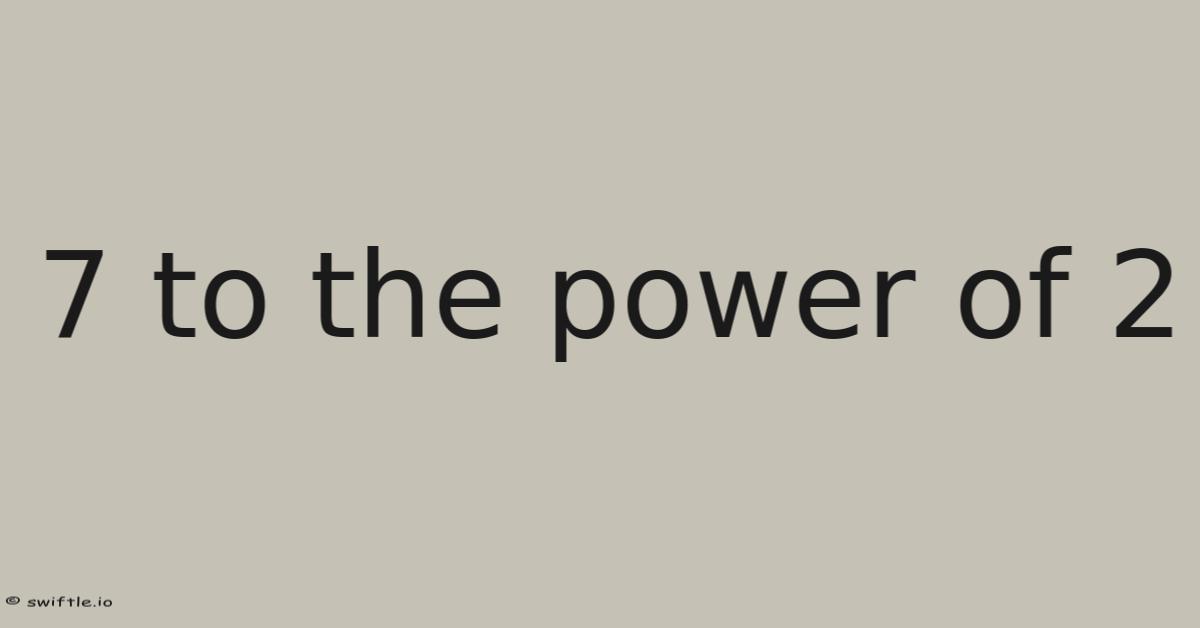
So you need to calculate 7 to the power of 2. Also, maybe you're doing homework, maybe you're just curious about exponents, or perhaps you're double-checking a math problem. Whatever the reason, this is one of those calculations that seems simple on the surface but actually reveals a lot about how exponents work. Let's break it down properly.
What Is 7 to the Power of 2?
At its core, 7 to the power of 2 means multiplying 7 by itself once. That's what exponents do — they tell you how many times to multiply a number by itself. So 7² = 7 × 7 = 49.
The little 2 is called an exponent, and the 7 is the base. You could write this as 7² or 7^2 — both mean the same thing. The exponent is always the smaller number up top or to the right, indicating repeated multiplication.
Breaking Down the Components
Here's what's happening mathematically:
- Base: 7 (the number you're multiplying)
- Exponent: 2 (how many times to multiply it by itself)
- Result: 49
When the exponent is 2, we call it "squared." So 7 squared equals 49. This isn't just a random piece of math vocabulary — "squared" actually comes from geometry. A 7×7 square has an area of 49 square units.
Why It Matters
You might think, "So what? Practically speaking, 7 times 7 is 49. Which means " But understanding this calculation opens doors to bigger concepts. Exponents are everywhere once you start looking — compound interest, population growth, computer processing power, even the Richter scale for earthquakes.
In practical terms, if you're shopping and see "7² items on sale," you know exactly what that means. If you're coding and need to calculate memory allocations or game scores, you'll likely use this exact calculation.
Real-World Applications
Here are places you'll actually use 7²:
- Area calculations: A square room that's 7 feet on each side has an area of 49 square feet
- Game scoring: Many games multiply points by powers of numbers
- Pattern recognition: Recognizing that 7² = 49 helps with mental math shortcuts
- Science calculations: Basic physics formulas often involve squaring numbers
How It Works: The Math Behind the Magic
Let's walk through exactly what happens when you calculate 7².
Step 1: Identify the Base and Exponent
You start with 7². The base is 7, and the exponent is 2. The exponent tells you to multiply the base by itself 2 times — but here's where people trip up, and I'll explain why.
Step 2: Apply the Exponent
When we say "multiply by itself 2 times," we actually write: 7 × 7
Notice we only write 7 twice, not three times. The exponent of 2 means we use the base 2 times in our multiplication. This is a common point of confusion, so let me make it crystal clear.
Step 3: Perform the Multiplication
7 × 7 = 49
That's it. You've calculated 7 squared.
Why This Pattern Works
The pattern continues with higher exponents:
- 7¹ = 7 (just one 7)
- 7² = 7 × 7 = 49 (two 7s multiplied together)
- 7³ = 7 × 7 × 7 = 343 (three 7s multiplied together)
- 7⁴ = 7 × 7 × 7 × 7 = 2,401 (four 7s multiplied together)
Each time you increase the exponent by 1, you multiply by another 7.
Common Mistakes People Make
Honestly, this is the part most guides get wrong. People make surprisingly similar errors with basic exponents.
Mistake #1: Counting Wrong
Some people think 7² means multiply 7 by itself 2 times, so they do 7 × 7 × 7. That gives them 343, which is actually 7³. The exponent tells you how many numbers to multiply, not how many multiplication signs to write.
Mistake #2: Confusing Squaring with Doubling
Others think 7² means double 7, so they get 14. But squaring a number gives you the area of a square with that side length, not twice the number.
Mistake #3: Forgetting the Base
When working with larger calculations, people sometimes forget they're multiplying 7 by 7 specifically, and they apply the exponent to the wrong number.
Continue exploring with our guides on how many 1/3 cups make 1 cup and how long does it take to walk 5 miles.
Mistake #4: Calculator Button Confusion
Pressing the wrong buttons on a calculator is common. You might hit the exponent button but forget to clear previous entries, or you might press the square button without realizing it's already set to 2.
What Actually Works: Practical Tips
Here's the straightforward approach that never fails.
Tip 1: Use the Definition
Remember: the exponent tells you how many times to multiply the base by itself. For 7², that's two 7s: 7 × 7 = 49.
Tip 2: Memorize Common Squares
Memorizing squares up through 10 makes everything faster:
- 1² = 1
- 2² = 4
- 3² = 9
- 4² = 16
- 5² = 25
- 6² = 36
- 7² = 49 ✓
- 8² = 64
- 9² = 81
- 10² = 100
This isn't just busywork — it builds number sense and speeds up mental math.
Tip 3: Check Your Work
Multiply it out again. Even so, if you got 49, verify: 7 × 7. Seven times 7 is indeed 49. Seven times 8 would be 56, so you can catch errors this way.
Tip 4: Use Visual Aids
Draw a 7×7 square and count the total boxes. This visual representation helps cement the concept that squaring means area calculation.
Tip 5: Practice with Patterns
Notice that 7² = 49 ends in 9. All squares of numbers ending in 7 will end in 9. So 17², 27², 37² — they all end in 9. This pattern recognition speeds up checking your work.
FAQ
Q: What's the difference between 7² and 2⁷? A: They're completely different calculations. 7² = 49, while 2⁷ = 128. The base and exponent matter in different ways.
Q: Is 7² the same as 7 × 2? A: No way. 7² = 49, but 7 × 2 = 14. Exponents aren't multiplication by the exponent number.
Q: How do I calculate 7² without a calculator? A: Just multiply 7 × 7 in your head. Or break it down: 7 × 7 = 7 × (5 + 2) = 35 + 14 = 49.
Q: What's the square root of 7²? A: The square root of 49 is 7. That's what square roots undo — they reverse squaring.
Q: Does 7² work the same way with negative numbers? A: Yes. (-7)² = 49 too, because negative times negative equals positive. But -7² (without parentheses) equals -49.
The Bigger Picture
Here's what most people miss: 7² isn't just a calculation. It's a gateway to understanding exponential growth, which shapes everything from finance to biology to technology. When you truly grasp that 7² = 49 through multiplication, not magic, you're building mathematical intuition that serves you for life.
The next time you see an exponent, whether it's 7², 3⁴, or 12⁵, you'll know exactly what's happening. You're
building a foundation for more advanced mathematical concepts. Day to day, squaring numbers is fundamental in geometry when calculating areas, in algebra when solving quadratic equations, and in statistics when working with standard deviations. Understanding that 7² = 49 isn't just about getting the right answer—it's about developing a mindset for breaking down complex problems into manageable parts.
Mastering exponents early on also prevents confusion later. And when you encounter expressions like 7³ or 7⁻², you’ll recognize them as extensions of the same principle. Still, exponents aren’t arbitrary symbols; they follow logical rules that, once internalized, make higher-level math far less intimidating. This clarity is especially crucial in fields like computer science, where exponential growth models everything from data storage to algorithm efficiency.
Beyond that, the confidence gained from accurately computing squares translates into better problem-solving skills across disciplines. In real terms, whether you're estimating square footage for a room or analyzing trends in data, the ability to quickly and correctly handle exponents saves time and reduces errors. It’s a small skill with outsized impact.
Conclusion
Squaring numbers like 7² = 49 may seem simple, but nailing the basics prevents cascading mistakes in advanced math. Here's the thing — this foundational knowledge isn’t just about arithmetic; it’s about fostering a deeper understanding of how numbers behave, setting you up for success in algebra, geometry, and beyond. By using clear strategies—multiplying it out, memorizing common squares, and recognizing patterns—you build both accuracy and intuition. Take the time to master these fundamentals now, and they’ll pay dividends in every math class you take.
