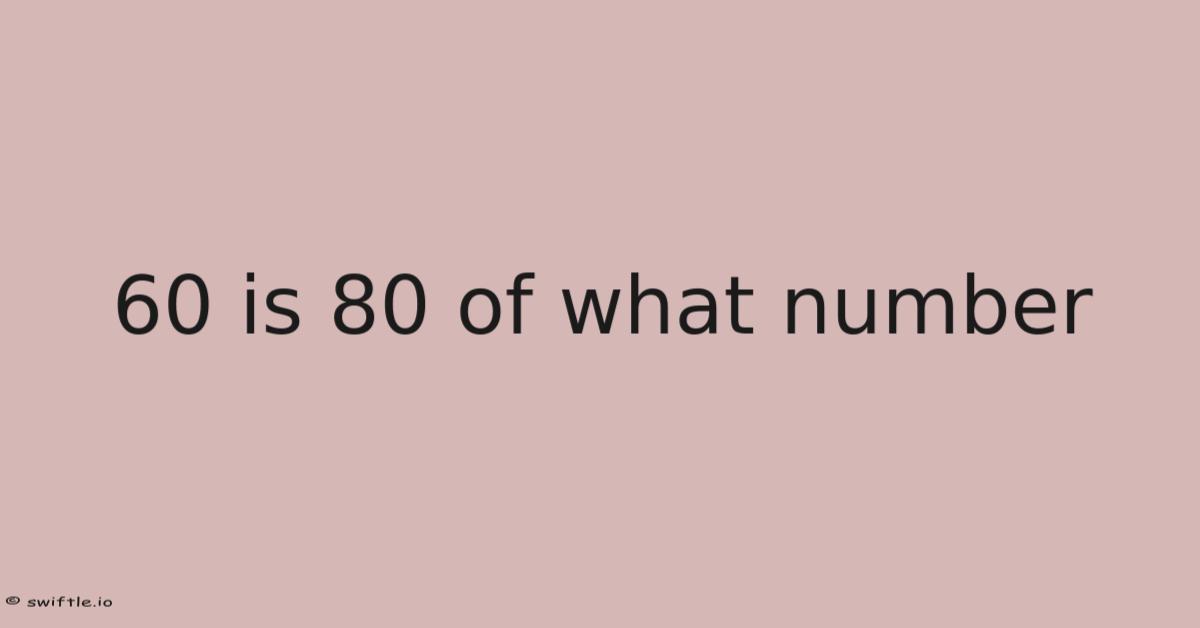
The Answer Is 75, But Here's Why This Problem Trips Up So Many People
If you've been staring at "60 is 80 of what number?Now, " for more than thirty seconds, you're not alone. That said, this question shows up everywhere — math homework, standardized tests, real estate calculations, even casual conversations about percentages. And yet, something about it makes people freeze.
Here's the thing — it's not that the math is hard. It's that the wording throws us off. " not the reverse. Even so, we're used to seeing problems like "What is 80% of 60? So our brain stumbles, tries to force the numbers into a familiar pattern, and ends up confused.
Most people don't realize how important this is.
Let me walk you through exactly what's happening here, why it matters, and how to think about these problems so they never trip you up again.
What This Problem Actually Asks
Breaking Down the Language
When we say "60 is 80 of what number," we're really asking: *80% of what number equals 60?So we're looking for a number that, when multiplied by 80% (or 0.So * The word "of" in math language typically means multiplication, and "is" means equals. 8), gives us 60.
It's worth noting — this step matters more than it seems.
This is a classic percentage problem, and it's the kind of thing you encounter daily without realizing it. Real talk — if you've ever calculated a tip, figured out a sale price, or wondered how much you originally paid for something after tax, you've been working with this same relationship.
The Simple Translation
Let's translate this into an equation:
0.8 × x = 60
Where x is the unknown number we're trying to find. Think about it: from here, it's straightforward algebra — divide both sides by 0. 8 to solve for x.
Why This Matters More Than You Think
It's Not Just Math Class
Understanding how to solve "60 is 80% of what number?" matters because percentages are everywhere in adult life. You'll use this skill when:
- Shopping during sales and needing to calculate original prices
- Figuring out interest rates on loans or savings
- Understanding salary increases or decreases
- Analyzing data in reports or news articles
- Calculating commissions or bonuses
I know it sounds simple — but it's easy to miss when you're just going through the motions. On the flip side, the people who truly get this concept can make faster, better financial decisions. They can spot when a "50% off" sale isn't actually as good as it sounds, or when a salary increase doesn't keep up with inflation.
What Goes Wrong When You Don't Get It
When people don't understand this relationship, they make costly mistakes. I've seen someone pass on a great investment opportunity because they couldn't quickly calculate the return percentage. I've watched people overpay for items because they couldn't mentally reverse-calculate the original price from a discount.
The short version is: this isn't just busywork. It's practical literacy.
How to Solve It Step by Step
Method 1: The Algebraic Approach
Basically the most reliable method, and it works for any percentage problem of this type.
- Set up the equation: 80% × x = 60
- Convert to decimal: 0.8 × x = 60
- Solve for x: x = 60 ÷ 0.8
- Calculate: x = 75
So 60 is 80% of 75.
Method 2: The Proportion Method
Some people find this more intuitive:
- Set up a proportion: 60/x = 80/100
- Cross multiply: 60 × 100 = 80 × x
- Simplify: 6000 = 80x
- Solve: x = 6000 ÷ 80 = 75
Same answer, different path.
Method 3: The Thinking Method
If you're good at mental math, you might reason it out:
"80% is the same as 4/5. If 60 is 4/5 of the number, then 1/5 is 60 ÷ 4 = 15. So the whole number is 15 × 5 = 75."
This method is fastest once you're comfortable with fraction equivalents, but it requires practice.
Common Mistakes People Make
Mixing Up the Numbers
Here's what most people get wrong first — they flip the problem. They try to calculate 80% of 60 instead of figuring out what number 60 represents 80% of. That gives them 48, which is wrong, but it feels right because it follows the familiar pattern.
Why does this matter? In real terms, because in real life, mixing up which number is the part and which is the whole leads to serious errors. Imagine calculating a tip by taking 15% of your total bill instead of figuring out what the original amount was before tax.
Continue exploring with our guides on how many minutes in 8 hours and what is 2 and 2/3 as a decimal.
Forgetting to Convert Percentages
Another classic mistake is leaving 80 as 80 instead of converting it to 0.This throws off the entire calculation. In practice, 8. Think about it: you end up dividing by 80 instead of 0. 8, which gives you a wildly different (and wrong) answer.
Decimal Point Errors
Even when people convert correctly, they sometimes misplace the decimal point. Dividing by 0.Day to day, 8 is the same as multiplying by 1. 25, but if you lose track of that relationship, you can easily end up with 480 instead of 75.
Practical Tips That Actually Work
Check Your Answer
Always verify your solution. If 60 is 80% of 75, then 80% of 75 should equal 60. Quick check: 0.8 × 75 = 60. Most people skip this — try not to.
This habit alone will catch most errors and build confidence in your calculations.
Learn the Key Fraction Equivalents
Memorize these common conversions — they'll speed up your mental math:
- 50% = 1/2
- 25% = 1/4
- 20% = 1/5
- 10% = 1/10
- 80% = 4/5
With these memorized, you can often solve problems in your head faster than pulling out a calculator.
Use Estimation First
Before doing exact calculations, estimate the answer. On top of that, since 80% is close to 100%, the answer should be slightly larger than 60. If you get 48 or 480, you know something went wrong.
This estimation habit is worth developing — it's saved me from plenty of embarrassing calculation errors in real-world situations.
Practice with Real Examples
Don't just solve abstract problems. Practice with real scenarios:
- "This $60 item is 80% of what it cost originally"
- "If I've completed 60% of my project and that's 80 hours, how long is the whole project?"
- "After a 20% discount, I paid $60. What was the original price?"
Connecting math to real situations makes it stick better.
FAQ
How do I know if I should multiply or divide?
Look at what you're solving for. If you're finding a part of a whole, multiply. Which means in "60 is 80% of what number," you're finding the whole, so you divide 60 by 0. If you're finding the whole given a part, divide. 8.
If you take away one thing from this section, make it this.
Can I use a calculator for this?
Absolutely — but don't rely on it blindly. Understanding the process helps you catch input errors and estimate whether your answer makes sense.
What if the percentage is over 100%?
The same method applies. If you have "60 is 120% of what number," you'd set up 1.2 × x = 60 and solve x = 50.
Why not just use a percentage calculator app?
Apps are fine for checking work, but understanding the underlying math makes you faster and more confident. Plus, you won't always have
access to technology when you need it.
Common Scenarios and Solutions
Sales and Discounts
When shopping, you'll frequently encounter percentage calculations. Calculate 0.That said, if a $60 item is marked down 20%, you need to find 20% of 60 and subtract it from the original price. 2 × 60 = 12, so the sale price is $60 - $12 = $48.
Alternatively, if you know you're paying 80% of the original price (after a 20% discount), you can work backwards. If $48 represents 80%, then the original price was $48 ÷ 0.8 = $60.
Tax Calculations
Adding sales tax follows a similar pattern. If your pre-tax total is $60 and the tax rate is 8%, calculate 0.08 × 60 = $4.80 in tax, making your grand total $64.80.
Interest and Finance
Understanding percentages is crucial for financial decisions. So if you earn 5% interest on $1,000, you'll receive $1,000 × 0. 05 = $50 in interest.
Building Confidence Through Practice
The key to mastering percentage calculations isn't memorizing formulas—it's understanding the relationships between parts and wholes. When you internalize that 80% means 0.8, and that dividing by a decimal gives you a larger number than your starting value, these problems become intuitive rather than mechanical.
Start with simple examples and gradually increase complexity. The more you practice connecting the abstract math to concrete situations, the more natural these calculations will feel.
Remember: every expert was once a beginner who refused to give up. With consistent practice and attention to these common pitfalls, you'll soon find yourself breezing through percentage problems that once seemed daunting.
The goal isn't just to get the right answer—it's to understand why that answer makes sense. Think about it: when you can explain to someone else why dividing by 0. 8 gives you the correct result, you've truly mastered the concept.
