## What’s the Deal with “5 Less Than a Number Is 15”?
Let’s start with a question: Have you ever stared at a math problem that felt like it should be simple, only to realize you’re missing something obvious? That’s exactly what happens with the phrase “5 less than a number is 15.” At first glance, it sounds like a riddle you’d hear at a dinner party—“I’m thinking of a number. If I subtract 5 from it, I get 15. What’s the number?” But here’s the thing: This isn’t just a party trick. It’s a foundational concept in algebra, and understanding it can save you from those “Wait, why is this so hard?” moments later on.
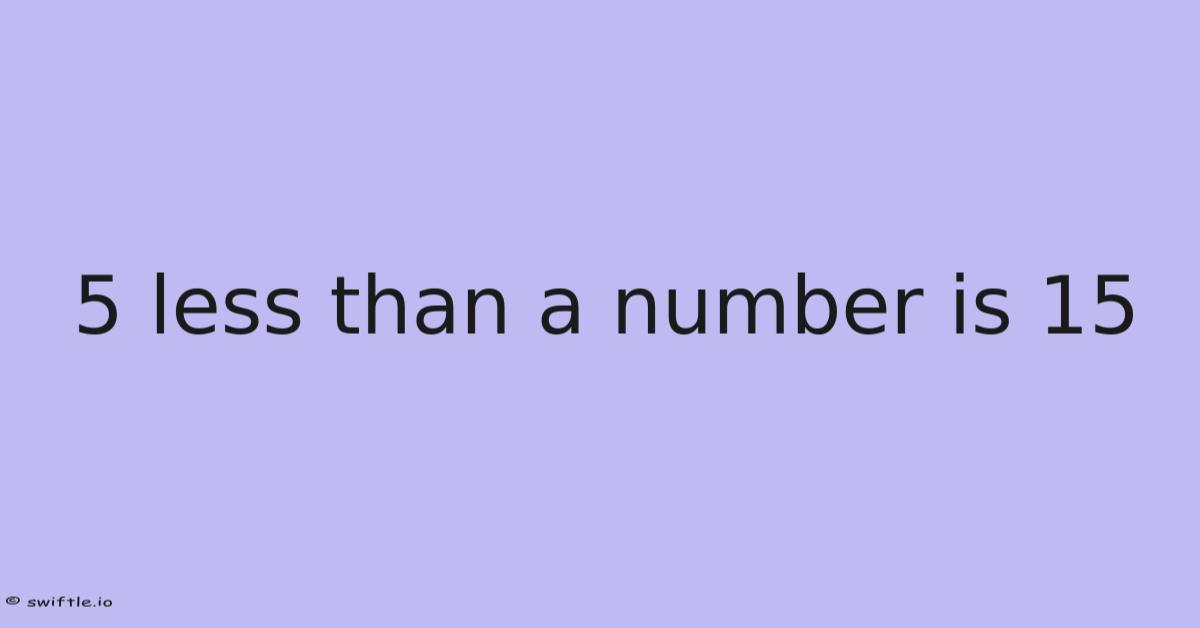
The short version is this: The number is 20. But why? Let’s break it down. Worth adding: when someone says “5 less than a number,” they’re describing a relationship between two values. The number (let’s call it x) minus 5 equals 15. In math terms, that’s x - 5 = 15*. Solving for x means adding 5 to both sides, which gives you x = 20*. Easy, right? But here’s the catch: Many people trip up on the phrasing. They might misinterpret “5 less than a number” as “the number minus 5,” which is technically correct, but the confusion comes when they reverse the order. In practice, for example, thinking it’s 5 - x = 15 instead. That’s a common mistake, and it’s why this problem is worth revisiting.
## What Is “5 Less Than a Number” Really?
Let’s get technical for a moment. The phrase “5 less than a number” is an example of a subtraction expression. In algebra, this is written as x - 5*, where x represents the unknown number. The key here is the order of operations. The phrase “less than” always means you subtract the smaller number from the larger one. So, “5 less than x” is x - 5*, not 5 - x. This is a critical distinction. If you reverse the order, you’re not just solving a different problem—you’re solving the wrong one.
Here’s a real-world analogy: Imagine you have a bag of apples. If you take away 5 apples, you’re left with 15. Day to day, how many apples did you start with? The answer is 20. But if you thought the problem was “5 apples less than your bag,” you might mistakenly subtract 5 from 15, which would give you 10. That’s not right. The phrasing “less than” always points to the original quantity being larger. It’s like saying, “If I have 20 apples and give away 5, I have 15 left.” The original number (20) is the bigger value, and the subtraction (5) is what’s taken away.
## Why Does This Matter in Real Life?
You might be thinking, “Okay, cool. But why does this matter?” Well, here’s the thing: Algebra isn’t just for math class. It’s everywhere. Think about budgeting. If you know that after spending $5, you have $15 left, you can figure out how much money you had initially. Or consider travel: If a trip takes 5 hours less than your planned time, and it actually took 15 hours, you can calculate how long you originally thought it would take. These are practical applications of the same principle.
Another example: Let’s say you’re comparing prices. But if a shirt costs $5 less than a jacket, and the shirt is $15, the jacket must be $20. Also, this is the same logic. The phrasing “less than” helps you identify which value is the original one. It’s not just about solving equations—it’s about understanding relationships between numbers. And that’s a skill that comes in handy far beyond the classroom.
## Common Mistakes and How to Avoid Them
Now, let’s talk about the pitfalls. The most common error is misinterpreting the phrase “5 less than a number.” Some people think it means “the number minus 5,” which is technically correct, but the confusion comes when they don’t recognize the order. Take this case: if the problem says “5 less than a number is 15,” the correct equation is x - 5 = 15*. But if you write 5 - x = 15, you’re solving for a negative number, which doesn’t make sense in this context.
Another mistake is forgetting to isolate the variable. Let’s say you start with x - 5 = 15*. To solve for x, you need to add 5 to both sides. If you skip this step, you’ll end up with x = 15*, which is wrong. It’s a simple fix, but it’s easy to overlook, especially if you’re rushing. The key is to treat the equation like a balance. Whatever you do to one side, you must do to the other.
## Practical Tips for Solving Similar Problems
So, how do you avoid these mistakes? Here’s a quick checklist:
- Identify the unknown number: Let’s call it x.
- Translate the words into an equation: “5 less than a number” becomes x - 5*.
- Set it equal to the given value: “Is 15” becomes x - 5 = 15*.
- Solve for x: Add 5 to both sides.
- Double-check your answer: Plug it back into the original problem.
Let’s test this with a different example. Solving it gives x = 13*. Still, if you reverse the order, you’d get 3 - x = 10, which would mean x = -7*. But that’s not the answer we’re looking for. Which means if the problem says, “3 less than a number is 10,” the equation is x - 3 = 10*. The phrasing “less than” is your guide.
Continue exploring with our guides on how long does it take to walk 5 miles and how many months is 90 days.
## Why This Problem Is a Gateway to Bigger Concepts
This simple problem is more than just a math exercise. It’s a stepping stone to understanding variables, equations, and algebraic thinking. Once you grasp how to translate words into equations, you’re ready to tackle more complex problems. To give you an idea, if a problem says, “Twice a number minus 7 is 15,” you’d write 2x - 7 = 15. The same logic applies, but with an extra step.
It also builds critical thinking skills. When you’re forced to interpret phrases like “less than” or “more than,” you’re not just memorizing rules—you’re learning how to analyze language and structure. This is especially useful in fields like engineering, economics, and computer science, where problem-solving is a daily requirement.
## Real-World Applications You Might Not Expect
Here’s a twist: This concept isn’t just for math tests. It’s used in everyday decision-making. To give you an idea, if you’re planning a road trip and know that the return journey is 5 hours shorter than the trip to your destination, and the return trip took 15 hours, you can figure out how long the original trip was. The math is the same: x - 5 = 15*, so x = 20*.
Another example: Imagine you’re comparing two phone plans. Plan A costs $5 less than Plan B. If Plan A is $15, Plan B must be $20. On top of that, this is the same logic. The phrasing “less than” helps you identify which plan is the original, more expensive one. It’s a simple concept, but it’s powerful when applied to real-life scenarios.
## The Short Version: Why It’s Worth Knowing
Let’s recap. The problem “5 less than a number is 15” is a straightforward equation: x - 5 = 15*. Solving it gives x = 20*. But the real value lies in understanding the
understanding the way everyday language encodes mathematical relationships. Plus, when you internalize that “less than” signals subtraction with the unknown first, you gain a mental tool that works far beyond textbook exercises. Day to day, for example, a problem might read, “Four more than twice a number is equal to three less than five times the same number. In real terms, this skill becomes especially valuable when you encounter multi‑step word problems, where several phrases must be parsed in sequence. ” Translating each clause—“twice a number” → 2x, “four more than” → 2x + 4, “three less than five times the number” → 5x − 3—lets you set up the equation 2x + 4 = 5x − 3 and solve for x with confidence.
Teachers often reinforce this translation process by having students rewrite sentences in symbolic form before attempting any arithmetic. Practicing this habit reduces the likelihood of reversing terms, a common error that leads to negative or nonsensical answers. It also builds a bridge to more abstract algebraic concepts such as functions, inequalities, and systems of equations, where the same principle of mapping verbal descriptions to symbolic expressions remains central.
In professional settings, the ability to move fluidly between language and mathematics improves communication across disciplines. A project manager might need to convey budget constraints to a finance team, a data analyst may have to explain model assumptions to stakeholders, and a software developer often translates user requirements into logical conditions. Mastery of the simple “less than” construction lays the groundwork for these higher‑level translations.
The bottom line: the modest equation x − 5 = 15* is more than a arithmetic exercise; it is a microcosm of algebraic thinking. Even so, by recognizing how everyday phrasing maps to mathematical operations, you equip yourself with a versatile problem‑solving mindset that applies to academics, careers, and everyday decisions alike. Embrace this habit, and you’ll find that even the most daunting word problems become approachable, one clear translation at a time.
