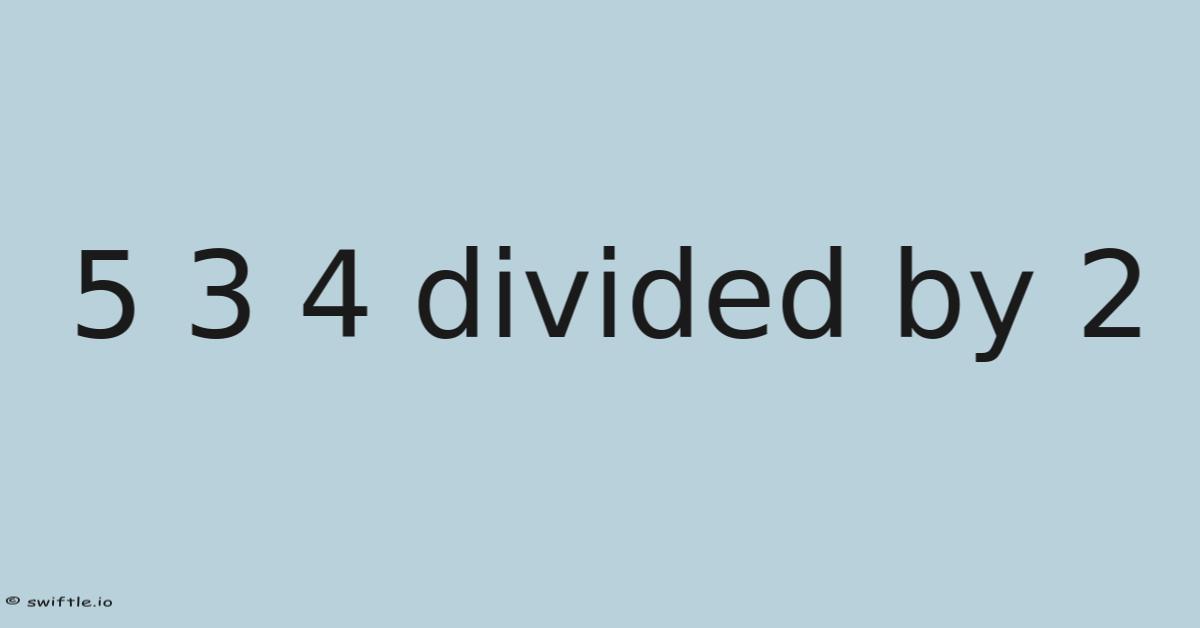
You’re staring at a worksheet, and the problem reads 5 3 4 divided by 2. At first glance it looks like a typo, or maybe a secret code. On the flip side, you wonder if the spaces are meant to be ignored, or if you’re supposed to treat each digit separately. It’s the kind of thing that makes you pause, scratch your head, and wonder whether you missed a lesson somewhere along the way.
The truth is, this little expression is a great excuse to talk about how we read numbers, how we break them down, and why a simple division can reveal a lot about our mental math habits. Let’s walk through it together, step by step, and see what’s really happening when we divide 5 3 4 by 2.
What Is 5 3 4 Divided by 2
When you see the string “5 3 4 divided by 2”, the first thing to decide is what the spaces mean. In everyday writing we usually don’t put spaces between the digits of a number, so the most natural reading is to treat “5 3 4” as the three‑digit number 534. The instruction then becomes: take 534 and divide it by 2.
That’s it—no hidden tricks, no extra operations. The expression is just a slightly unconventional way of writing the division problem 534 ÷ 2. If you were to write it in a more standard format you’d see:
534
÷  2
or, using a fraction bar, 534⁄2. The answer, as you’ll see in a moment, is 267.
Why does the spacing matter at all? Because if you interpreted each digit as a separate entity you might be tempted to do something like (5 ÷ 2) + (3 ÷ 2) + (4 ÷ 2) or even 5 ÷ (3 ÷ 4 ÷ 2). Those paths lead to very different results and are a common source of confusion. Recognizing that the spaces are merely visual separators—and not mathematical operators—is the first step to solving the problem correctly.
Why It Matters / Why People Care
You might be thinking, “Who cares about one division problem?And ” Fair question. But the exercise touches on a few skills that show up everywhere, from balancing a checkroom to splitting a bill at a restaurant.
First, it reinforces place value. Which means seeing “5 3 4” and instantly recognizing it as five hundreds, three tens, and four ones is a quick mental check that you’re not mixing up the digits. Consider this: second, it encourages you to look for the simplest interpretation before diving into complicated alternatives. In real life, we often face ambiguous instructions—whether it’s a vague email request or a poorly formatted spreadsheet—and the habit of pausing to clarify what’s actually being asked saves time and mistakes.
Finally, there’s a confidence boost that comes from being able to solve a problem in your head without reaching for a calculator. Knowing that half of 500 is 250, half of 30 is 15, and half of 4 is 2, then adding those together (250 +
…250 + 15 + 2, which totals 267. This quick “split‑and‑add” technique works because division by two distributes over addition: ½·(500 + 30 + 4) = ½·500 + ½·30 + ½·4.
If you prefer the classic long‑division layout, you’d set it up as
   267
2 │ 534
   -4   (2×2)
   ----
    13
   -12  (2×6)
   ----
     14
    -14 (2×7)
   ----
      0
Each step confirms that 2 goes into 5 twice (remainder 1), brings down the 3 to make 13, which yields six 2’s with a remainder of 1, and finally the remaining 14 divides cleanly into seven 2’s. The zero remainder tells us the division is exact.
Another mental shortcut is to halve each place value separately, as we just did, but you can also think of “534” as “500 + 30 + 4” and halve the sum, or even recognize that 534 is just 2 × 267 because 267 × 2 = (200 × 2)+(60 × 2)+(7 × 2) = 400+120+14 = 534. Spotting such factor pairs can be handy when you need to verify a result quickly.
At the end of the day, the exercise of interpreting “5 3 4 divided by 2” does more than produce a number; it sharpens our ability to parse ambiguous notation, reinforces place‑value intuition, and builds confidence in mental arithmetic. Day to day, by pausing to clarify what the symbols truly mean, we avoid unnecessary detours and arrive at the correct answer efficiently—whether we’re splitting a bill, measuring ingredients, or checking a spreadsheet. The next time you see a spaced‑out digit string, remember: the spaces are usually just visual aids, not hidden operations, and a clear, step‑by‑step approach will always lead you to the right result.
Beyond the classroom, the habit of pausing to decode a notation like “5 3 4 ÷ 2” proves invaluable in everyday decision‑making. That's why imagine a spreadsheet that lists quarterly revenues as “2 5 0 0 0”, and you need to know whether the figure is meant to be $250,000 or $25,000. By instantly recognizing the place values, you can avoid costly mis‑entries before the data even reaches the analyst’s desk. In budgeting, the same skill helps you break down a large expense—say, a $1,350 utility bill—into its component parts ($1,000 + $300 + $50) and quickly assess how a 10 % reduction would affect each segment.
Continue exploring with our guides on how many ounces in a half gallon and what is 1/8 + 1/8 teaspoon.
This part deserves a bit more attention than it usually gets.
Practice tricks to sharpen the skill
- Chunk the digits – Write numbers with spaces as you see them, then immediately rewrite them without spaces, labeling each column (hundreds, tens, ones). This reinforces the mental bridge between visual spacing and numeric value.
- Reverse‑engineer the divisor – If you suspect a hidden divisor, test small integers (2, 3, 5, 10) by halving, third‑ing, or tenth‑ing each place value. The first that yields whole numbers often signals the intended operation.
- Cross‑check with estimation – Before performing the exact calculation, ask yourself whether the result feels plausible. For “534 ÷ 2”, an estimate of “about 250” (half of 500) instantly flags any gross error.
- Use symmetry – Recognize that division by 2 is the same as multiplication by 0.5. Multiplying by 0.5 can be done by moving the decimal point one place left and adjusting for whole numbers (e.g., 534 × 0.5 = 267).
Real‑world scenarios
- Cooking: A recipe calls for “2 5 0 g” of flour, but the spacing is ambiguous. Interpreting it as 250 g lets you halve the batch without a calculator.
- Travel: A flight duration listed as “1 2 h” is clearly 12 hours; knowing the place values helps you convert to minutes (720 min) on the fly.
- Programming: When parsing user input that may contain spaces, a dependable routine first strips whitespace, then validates the numeric format, preventing runtime errors.
By treating spaced digits as a cue to verify meaning rather than a puzzle to solve, you cultivate a mindset of clarity that transcends arithmetic. The next time a number appears with unexpected gaps, remember: the spaces are not a mystery—they’re an invitation to pause, interpret, and act with confidence.
The habit of interrogating spaced numerals also pays dividends in fields where precision is non‑negotiable. Here's the thing — in engineering drawings, dimensions are sometimes rendered with gaps to improve readability — e. g., “12 3 4 mm” for 12.So 34 mm. Plus, recognizing that each block corresponds to a specific place value prevents costly mis‑cuts when the design moves from CAD software to the shop floor. And likewise, in financial reporting, analysts routinely encounter figures presented with thousands separators that vary by locale — “1 234 567” versus “1. 234.567”. By internalizing the rule that any consistent grouping signals a power‑of‑thousand multiplier, you can instantly convert between notations without reaching for a conversion table.
Teaching this skill early builds a resilient number sense that survives the transition from rote calculation to abstract problem‑solving. Classroom activities that ask students to rewrite spaced numbers in expanded form, then to reconstruct them from word problems, reinforce the link between visual parsing and algebraic thinking. When learners later encounter variables with subscripts or multi‑digit coefficients, the same instinct to “chunk” and verify each component reduces errors in manipulating expressions like ( (3 4 5) \times (2 0) ).
Technology can amplify, not replace, this mental habit. Spreadsheet validators that flag ambiguous entries — such as a cell containing “4 5 6” without a clear delimiter — prompt users to confirm intent before formulas are applied. Voice‑to‑text transcription services benefit similarly: when a spoken number is transcribed with inadvertent spaces, a post‑processing step that re‑assembles the digits based on context (e.Because of that, g. , recognizing a price versus a phone number) yields cleaner data pipelines.
The bottom line: the power lies not in memorizing a trick but in cultivating a reflexive pause. This simple pause transforms a potential source of confusion into an opportunity for clarity, ensuring that the numbers you work with — whether on a page, a screen, or a ledger — convey exactly what they mean. Whenever a numeral appears with unexpected spacing, treat it as a signal to verify the underlying place‑value structure, test plausible interpretations, and choose the one that aligns with the surrounding context. By embracing spaced digits as helpful cues rather than obstacles, you sharpen both your arithmetic intuition and your broader capacity for precise, confident decision‑making.
