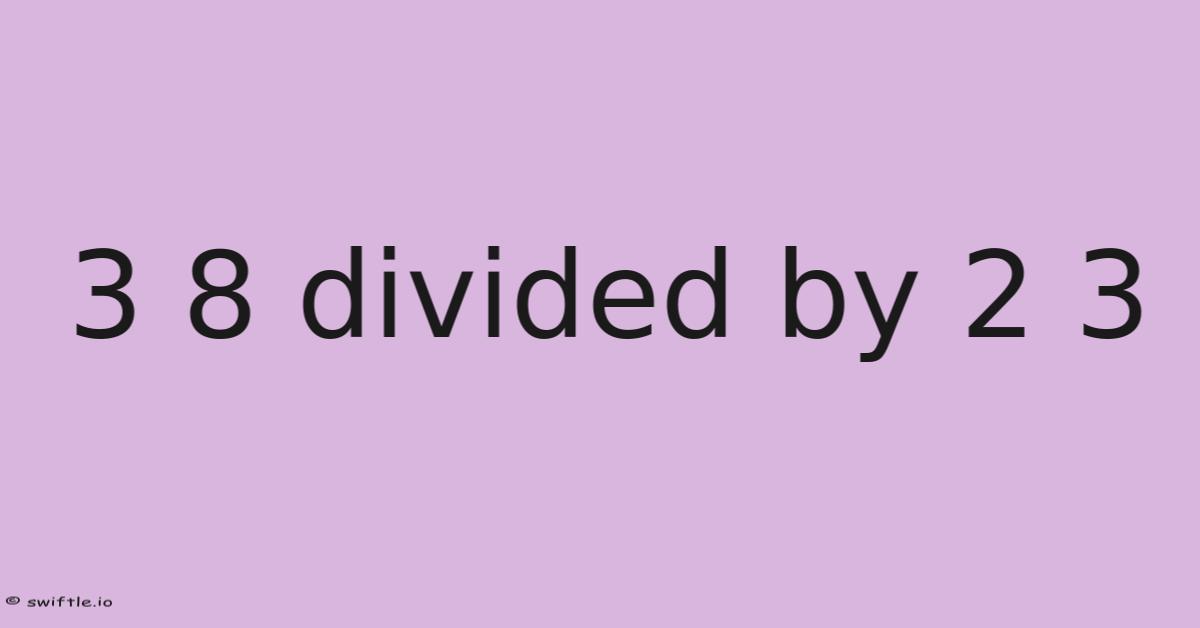
The Simple Question That Trips Up Half the Internet
What's 3/8 divided by 2/3? Sounds like basic math, right? But here's the thing — this little fraction division problem shows up everywhere, from cooking recipes to construction measurements to standardized tests. And somehow, it manages to confuse a shocking number of people.
Maybe it's the fractions. Maybe it's the division. Or maybe it's that voice in your head whispering, "Wait, do I flip both fractions? So just one? Neither?
Let's clear this up once and for all.
What 3/8 Divided by 2/3 Actually Means
Before we dive into the calculation, let's talk about what this problem really asks. When you see 3/8 ÷ 2/3, you're essentially asking: "How many groups of 2/3 fit into 3/8?"
Think of it like this — if you have 3/8 of a pizza, and each person wants to eat 2/3 of what's available, how many people can you feed? (Okay, that's a weird example, but you get the idea.)
The Key Insight: Division Means Multiplication by the Reciprocal
Here's what most people forget from middle school: dividing by a fraction is the same as multiplying by its reciprocal. That's the golden rule here.
So 3/8 ÷ 2/3 becomes 3/8 × 3/2.
Why? So because the reciprocal of 2/3 is 3/2. You flip the numerator and denominator.
Why This Matters More Than You Think
Fraction division isn't just busywork from math class. It's the foundation for so many real-world skills:
- Cooking and baking: Doubling or halving recipes
- Construction and DIY: Calculating material quantities
- Finance: Understanding interest rates and proportions
- Science: Working with ratios and concentrations
Get this wrong, and you're doubling a recipe that should be halved. Now, or ordering way too much lumber. Or miscalculating medication dosages.
The short version is: fraction division is everywhere, and getting comfortable with it pays off.
How to Solve 3/8 Divided by 2/3 (Step by Step)
Let's walk through this properly.
Step 1: Identify the Problem
We start with: 3/8 ÷ 2/3
Step 2: Convert Division to Multiplication
Flip the second fraction (the divisor) and change the operation:
3/8 ÷ 2/3 = 3/8 × 3/2
Step 3: Multiply Straight Across
Multiply the numerators together, then the denominators:
Numerator: 3 × 3 = 9 Denominator: 8 × 2 = 16
So we get 9/16
Step 4: Simplify If Possible
Check if 9/16 can be reduced. The factors of 16 are 1, 2, 4, 8, 16. Which means the factors of 9 are 1, 3, 9. The only common factor is 1, so 9/16 is already in its simplest form.
The Final Answer: 9/16
Common Mistakes That Make People Pull Their Hair Out
I've seen smart adults stare at fraction problems for minutes, completely stuck. Here's why:
Mistake #1: Flipping Both Fractions
Some people think, "Division means flip, so I'll flip both!Here's the thing — " No. Only flip the second fraction — the one you're dividing by.
Wrong: 3/8 × 8/3 × 3/2 = chaos Right: 3/8 × 3/2 = 9/16
Mistake #2: Forgetting to Flip at All
Others try to divide straight across: 3÷2 over 8÷3, which gives 3/2 over 8/3. That's not how fraction division works, and it leads to unnecessary complexity.
Mistake #3: Cross-Multiplying Instead
Cross-multiplication works for comparing fractions or solving proportions, but it doesn't apply to division problems. Don't force it.
Mistake #4: Mixing Up Numerator and Denominator
When you flip 2/3 to get 3/2, make sure you actually flip it correctly. I've seen people write 2/3 and somehow end up with 2/3 again. Double-check your work.
Practical Tips That Actually Work
Here's what helps when you're stuck:
If you found this helpful, you might also enjoy how many football fields in a mile or how many water bottles is 2 litres.
Tip #1: Always Check Your Work With Decimals
Convert the original fractions to decimals: 3/8 = 0.375 and 2/3 ≈ 0.667
Now divide: 0.375 ÷ 0.667 ≈ 0.563
Convert your answer back: 9/16 = 0.5625
Close enough? Yes. You did it right.
Tip #2: Use Visual Models When Learning
Draw rectangles. Shade 3/8 of one and 2/3 of another. See how many times the second fits into the first. This isn't practical for every problem, but it builds intuition.
Tip #3: Memorize the Process, Not Just the Answer
The next time you see a fraction division problem, your brain should automatically think: "Flip the second fraction and multiply." Make it muscle memory.
Tip #4: Practice with Friendly Numbers First
Before tackling 3/8 ÷ 2/3, try 1/2 ÷ 1/4. Worth adding: that equals 1/2 × 4/1 = 4/2 = 2. Easy to verify. Build confidence, then scale up.
FAQ About Fraction Division
Do I always flip the first fraction?
No. Consider this: only flip the second fraction — the divisor. The first fraction stays exactly as it is.
What if I get an improper fraction as my answer?
That's totally fine. 9/16 happens to be proper, but answers like 5/3 or 16/5 are perfectly valid. Convert to mixed numbers only if the problem specifically asks for it.
Can I simplify before multiplying?
Absolutely. Which means if you notice common factors across numerators and denominators, simplify first. On the flip side, it makes the multiplication easier. As an example, if you had 6/8 × 4/3, you could simplify to 3/4 × 4/3 = 12/12 = 1.
Why does multiplying by the reciprocal work?
Think about what division really means. Dividing by 3 is the same as multiplying by 1/3. Because of that, dividing by 2 is the same as multiplying by 1/2. So dividing by 2/3 is the same as multiplying by 3/2. It's consistent.
What if both fractions are negative?
Same process. The negatives cancel out, and you multiply normally. (-3/8) ÷ (-2/3) = (-3/8) × (-3/2) = 9/16.
The Bigger Picture: Why Fraction Skills Matter
Look, I get it. In a world of calculators and phones, why bother memorizing fraction division?
Because math isn't about computation — it's about reasoning. Every time you work through a fraction problem, you're training your brain to think logically, break down complex problems, and spot patterns.
And honestly? Being the person who can quickly figure out "oh, that recipe needs to be cut in half" or "this board needs to be divided into pieces" without fumbling for a calculator? That's a quiet kind of confidence that pays off daily. Simple, but easy to overlook.
So the next time someone asks you what 3/8 divided by 2/3 is, you won't hesitate. You'll smile and say 9/16, because you know exactly how you got there.
And that's worth more than just getting the right answer.
Beyond the kitchen and the workshop, fraction division shows up in fields you might not expect. That said, in finance, calculating interest rates or splitting investments often requires dividing one fractional share by another. In science, diluting a solution to a precise concentration involves the same flip‑and‑multiply step. Even in everyday scheduling — figuring out how many 15‑minute blocks fit into a 2‑hour window — relies on dividing fractions of an hour.
If you’re looking to sharpen your skill further, try these quick exercises:
- Create your own problems. Write down two random fractions, swap them as divisor and dividend, and solve. Check your work with a calculator only after you’ve attempted it manually.
- Teach someone else. Explaining the “flip and multiply” rule to a friend or family member forces you to articulate the reasoning, which cements the concept in your own mind.
- Use visual aids sparingly. Draw a bar model for a tricky problem, then verify the result algebraically. The visual step builds intuition; the algebraic step reinforces precision.
Remember, mastery isn’t about memorizing a single answer; it’s about internalizing a reliable process that you can apply whenever numbers appear in parts rather than wholes. Each time you successfully divide fractions, you reinforce a logical framework that extends to algebra, ratios, and proportional reasoning — skills that prove invaluable in academics, careers, and everyday decision‑making.
So keep practicing, stay curious, and let the confidence you gain from handling fractions spill over into every other quantitative challenge you encounter. That's why the next time a fraction division problem pops up, you’ll tackle it with ease, knowing exactly why the method works and trusting that your reasoning is sound. That’s the true payoff: not just a correct answer, but a sharper, more adaptable mind.
