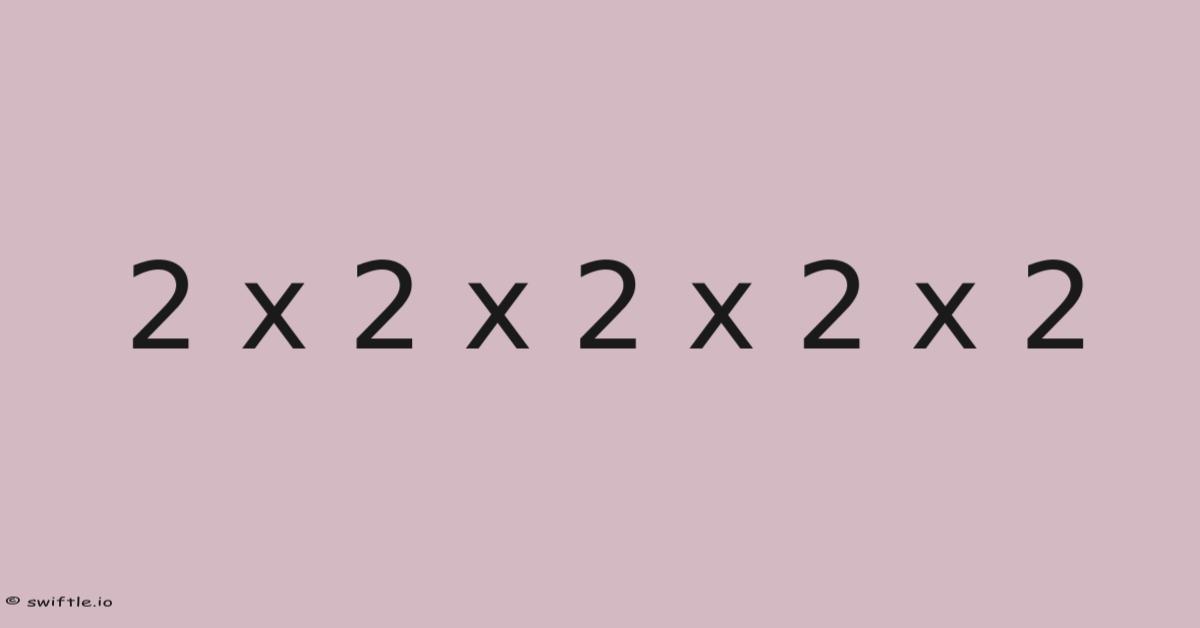
2 x 2 x 2 x 2 x 2 = 32.
Five twos multiplied together. Doesn't look like much on paper. Think about it: just a small number. The kind you'd skip over in a multiplication table.
But here's the thing — this specific calculation keeps showing up in places that matter. Computing. Think about it: biology. Music. Sports. The temperature at which water freezes. Once you start noticing it, you see it everywhere.
And no, this isn't numerology. It's structure.
What Is 2⁵ Actually
Let's be precise for a second. 2 × 2 × 2 × 2 × 2 is 2 raised to the 5th power. 2⁵. Five doublings.
Start with 1. Double it: 2. Double again: 4. Then 8. Then 16. Then 32.
Five steps. That's it.
In binary, 32 is 100000. Which means elegant. One followed by five zeros. Practically speaking, clean. The kind of number computers love because it aligns perfectly with how they think — in powers of two.
But 32 isn't special because computers like it. This leads to computers like it because 32 is special. There's a difference.
The doubling pattern
Each multiplication by 2 represents a binary choice. Yes/no. Also, present/absent. In real terms, on/off. With five independent binary choices, you get 32 possible combinations.
That's not a coincidence. That's information theory.
Why It Matters / Why People Care
You've encountered 32 today. Probably multiple times. You just didn't label it.
The 32-bit era
If you used a computer in the 90s or early 2000s, you lived in a 32-bit world. Windows 95. That said, the original PlayStation. So the Pentium processor. All 32-bit.
What that meant: the processor could handle memory addresses 32 bits long. 2³² possible addresses. 4,294,967,296 bytes. 4 GB of addressable memory.
At the time, that felt infinite. Now it's a constraint we hit constantly. But for two decades, 32 bits was the sweet spot — enough address space for serious work, cheap enough to put in every home.
We're mostly 64-bit now. But 32-bit code still runs everywhere. Your phone probably executes 32-bit instructions daily. The transition isn't done. It never fully is.
IPv4: the 32-bit address that ran out
Every device on the internet used to get a 32-bit address. Because of that, 168. Here's the thing — four octets. Even so, 1. Here's the thing — 192. Which means 1. That format.
2³² addresses. ~4.3 billion. Seemed like plenty in 1981.
We ran out. Completely. Also, the last blocks were allocated in 2011. That's why we're still here because of workarounds — NAT, private ranges, IPv6 adoption dragging its feet. But the 32-bit limit forced a global infrastructure redesign.
That's what happens when you underestimate exponential growth. Day to day, five doublings gets you to 32. Thirty-two doublings gets you to 4 billion. The curve doesn't care about your planning horizon.
How It Works (or How to Do It)
Let's break down where 2⁵ = 32 actually does work in practice.
In computing: 5 bits
Five bits. That's all you need to represent 32 distinct values.
- 32 ASCII control characters (0–31)
- 32 possible values in a 5-bit register
- The number of bits in a standard IPv4 address? No, that's 32 bits. Different thing.
- 5-bit Baudot code — early telegraphy, 32 characters. No lowercase. Just enough for basic teleprinters.
Five bits is the smallest power of two that gives you the alphabet plus* numbers plus* punctuation plus* control codes. And 6 bits gives you 64 — more comfortable. But 5 bits was the economic choice for early telegraphy. Every bit cost money on the wire.
In biology: human adult teeth
32 teeth. 16 upper, 16 lower. 8 in each quadrant.
If you found this helpful, you might also enjoy how many minutes are in 6 hours or how many football fields in a mile.
- 2 incisors
- 1 canine
- 2 premolars
- 3 molars (including wisdom teeth)
× 4 quadrants = 32.
Not everyone keeps all 32. But wisdom teeth often go. Some people are born with fewer. But the developmental blueprint? Here's the thing — 32. It's the standard human dental formula.
Why 32? Which means evolution doesn't optimize for round numbers. That's why it optimizes for function. 32 teeth fits the human jaw, the human diet, the human lifespan. The number emerges from constraints — not design.
In temperature: freezing point
32°F. Water freezes.
Fahrenheit didn't pick 32 arbitrarily. 32°F was the freezing point of water. Also, 96°F was body temperature (later adjusted to 98. He set 0°F as the coldest temperature he could reliably produce (ammonium chloride brine). 6°).
The scale divides the range between freezing and boiling (212°F) into 180 degrees. 180 = 6 × 30. Divisible by 2, 3, 4, 5, 6, 9, 10, 12, 15, 18, 20, 30, 36, 45, 60, 90.In real terms, 32 sits at the bottom of that divisible range. Convenient for calibration. Not magical — practical.
In music: 32-bar form
AABA. In practice, 32 bars total. Day to day, 8 bars each. The Great American Songbook standard.
"I Got Rhythm.Two 16-bar halves. Here's the thing — " "Over the Rainbow. " "All the Things You Are." Hundreds of jazz standards. In practice, 32 bars. Four 8-bar sections.
Why 32? Improvisers love it. Consider this: it's long enough to develop a melody, short enough to remember, divisible by 2, 4, 8, 16. Day to day, dancers love it. It's a structural sweet spot.
In sports: 32 teams
NFL. Because of that, 32 teams. 8 divisions of 4.2 conferences of 16.
FIFA World Cup. Five rounds. Consider this: 16 → 8 → 4 → 2 → 1. Which means clean bracket. And 8 groups of 4. Because of that, 32 teams (1998–2022). Five doublings in reverse.
The 2026 World Cup expands to 48. 32 was mathematically clean. The bracket gets messy. Sometimes clean loses to money.
In chess: 32 pieces
16 white. 16 black.
16 pawns. 8 pieces each: king, queen, two rooks, two bishops, two knights.
The starting position. Exactly half. Every piece has a role, a purpose, a path. 64 squares. The number 32 here is about symmetry and potential. That said, the board is a balanced ecosystem of attack and defense, mobility and structure. Also, 32 pieces. The game unfolds from this perfect, tense equilibrium.
In measurement: a fluid ounce
Not the imperial 28.That's why a quart is a quarter of a gallon. Still, 32 of them make a quart. So 4 ml, but the US customary fluid ounce. A gallon is 128 fluid ounces.
128.32 × 4. It’s a system built on powers of two, inherited from the British imperial system but simplified. 32 is a cornerstone of that messy, historical, yet deeply ingrained arithmetic. It’s the volume of a common milk carton, a pint and a half. A number you pour into a glass every day.
The Common Thread
So, what is 32?
It isn't a mystical number. It doesn't control the universe. It's a pattern that emerges from the edges of our world—the edges of wires, teeth, melodies, brackets, chessboards, and measuring cups.
It is 2 raised to the fifth power. Think about it: it is a boundary. A limit. Consider this: it is the number of steps between nothing and something, repeatedly halved or doubled. A design constraint.
We find 32 everywhere because it represents a fundamental human impulse: to divide, to organize, to create systems that are large enough to be functional but small enough to be manageable. The number of choices, the number of teeth, the number of bars, the number of teams, the number of pieces—all chosen not for cosmic significance, but because they work. That said, it is the architecture of the practical. They fit.
And that is the most remarkable thing of all. The number 32 is powerful not because it is special, but because we are the kind of creatures who keep finding ways to make it so.
