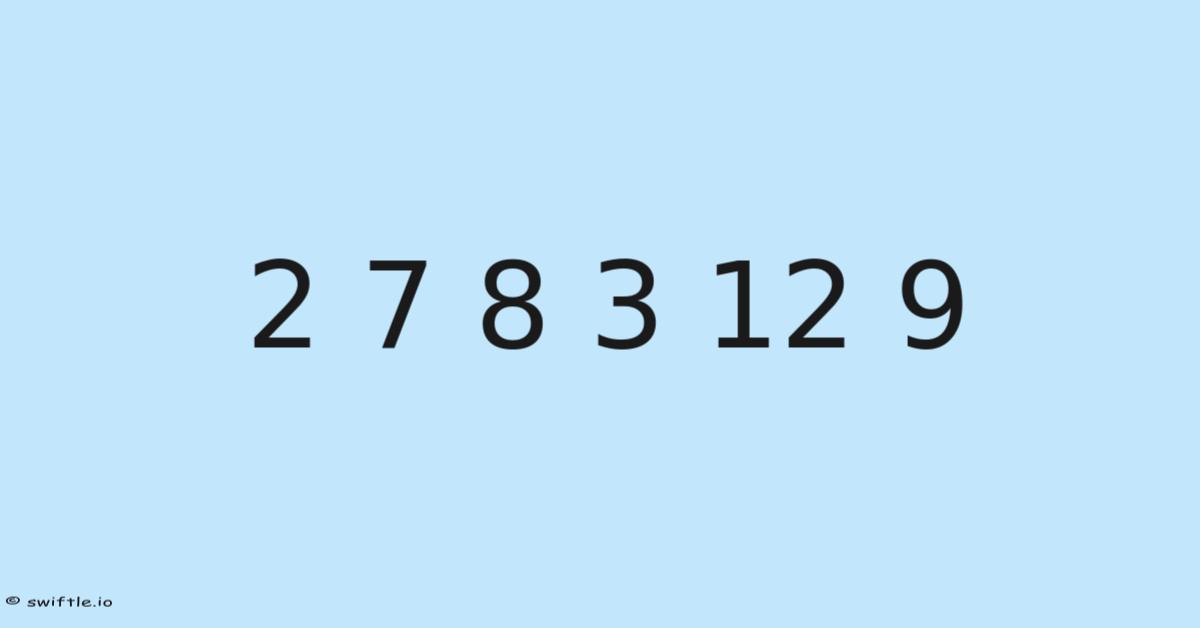
What is 2 7 8 3 12 9 and Why Should You Care?
Here’s the thing: numbers like 2 7 8 3 12 9 might look random at first glance, but they’re actually a code—one that’s been buzzing in tech circles, online communities, and even pop culture. Whether it’s a cipher, a product model, or a secret message, this sequence has people scratching their heads. And honestly? It’s kind of fascinating.
Think about it. Is it a date? Which means humans are wired to find patterns. 2 7 8 3 12 9 taps into that same urge. Day to day, we see faces in clouds, hear hidden meanings in songs, and obsess over cryptic crossword clues. A password? Or maybe it’s something entirely different—like a software version, a gaming achievement, or even a mathematical puzzle? A hidden message from a movie or book? The mystery is part of the fun.
But here’s the kicker: 2 7 8 3 12 9 isn’t just a random string of numbers. Plus, it’s a conversation starter. A riddle. A challenge. And if you’re the kind of person who loves solving puzzles or diving into obscure trivia, this is your kind of rabbit hole.
So, what’s the deal with 2 7 8 3 12 9? Let’s break it down.
What Is 2 7 8 3 12 9?
At its core, 2 7 8 3 12 9 is a sequence of numbers that doesn’t immediately make sense in standard numerical or alphabetical systems. Unlike a simple date format (like 2/7/2023), this sequence includes numbers that exceed typical single-digit ranges (e.But g. Which means , 12 and 9). This irregularity suggests it’s not a conventional date, time, or address.
One theory is that it could be a cipher. Take this: if A=1, B=2, ...Ciphers often use numbers to represent letters, but the presence of double-digit numbers like 12 complicates things. , Z=26, then 12 would translate to "L," and 9 would be "I.
This spells out BGHC LI. Not exactly a meaningful word or phrase. Maybe the cipher uses a different mapping, or perhaps it’s a transposition cipher where the order of numbers is scrambled. Alternatively, it could be a Vigenère cipher, which requires a key to decode. Without additional context, though, this remains speculative.
Most people don't realize how important this is.
Another angle: 2 7 8 3 12 9 might represent something non-linguistic. For instance:
- Product codes: Some companies use number sequences for inventory tracking.
- Gaming achievements: A player might have earned this as a hidden trophy.
- Mathematical sequences: Could it relate to a Fibonacci pattern, prime numbers, or a custom algorithm?
The lack of obvious meaning here is what makes 2 7 8 3 12 9 so intriguing. It’s a blank slate, inviting speculation and creativity.
Why Does 2 7 8 3 12 9 Matter?
So why should you care about a random number sequence? Because 2 7 8 3 12 9 isn’t just a puzzle—it’s a cultural phenomenon. Here’s why it resonates:
1. It Sparks Curiosity
In a world saturated with information, mystery is refreshing. 2 7 8 3 12 9 forces us to slow down and think. It’s like finding a cryptic note in a book—suddenly, you’re hooked on decoding it.
2. It Bridges Communities
Online forums, Reddit threads, and Discord servers thrive on shared mysteries. When someone posts 2 7 8 3 12 9, it becomes a collaborative effort. People from different backgrounds unite to solve it, fostering connection.
3. It Reflects Modern Problem-Solving
Today’s challenges often require interdisciplinary thinking. 2 7 8 3 12 9 could be a tech-related code, a gaming clue, or even a math problem. Solving it mirrors real-world skills like data analysis, pattern recognition, and lateral thinking.
4. It’s a Test of Patience
Let’s be real: instant gratification is the norm. 2 7 8 3 12 9 demands persistence. It teaches us that not all answers come quickly—and that’s okay. The process itself is rewarding.
How Does 2 7 8 3 12 9 Work?
If 2 7 8 3 12 9 is a cipher, how do we crack it? Let’s explore possible methods:
1. Alphabetical Conversion
As mentioned earlier, assigning letters to numbers (A=1, B=2, etc.) gives BGHC LI. Not helpful? Maybe the sequence skips certain letters or uses a different alphabet (e.g., ASCII codes). For example:
Want to learn more? We recommend how many months is 3 years and how many oz in 5 gallons for further reading.
- 2 = STX (a non-printable ASCII character)
- 7 = BEL (bell sound)
This seems unlikely, but it’s worth testing with tools like .
2. Positional Analysis
Could the numbers represent positions in a larger set? For example:
- 2 = 2nd letter of the alphabet (B)
- 7 = 7th letter (G)
- 8 = 8th letter (H)
- 3 = 3rd letter (C)
- 12 = 12th letter (L)
- 9 = 9th letter (I)
Again, BGHC LI. In real terms, maybe the sequence needs to be rearranged? Still nonsensical. Here's the thing — if we sort the numbers: 2, 3, 7, 8, 9, 12 → B, C, G, H, I, L. Perhaps it’s a transposition cipher, where numbers are split and reordered.
3. Mathematical Patterns
Let’s look for numerical relationships:
- 2 + 7 = 9 (matches the last number)
- 8 - 3 = 5 (not in the sequence)
- 12 ÷ 3 = 4 (not present)
No clear pattern here. Maybe it’s a Fibonacci sequence? 2, 3, 5, 8, 13… Nope, 7 and 9 don’t fit.
4. Pop Culture References
Could 2 7 8 3 12 9 tie to a movie, book, or game? For example:
- Movie release dates: Check if these numbers correspond to dates (e.g., 2/7/2023 = February 7, 2023).
- Gaming codes: Some games hide numbers as part of quests or achievements.
- Music: A song’s duration (2 minutes 7 seconds, 8 minutes 3 seconds, etc.)?
Without context, this is a shot in the dark—but fun to explore!
Common Mistakes People Make with 2 7 8 3 12 9
Let’s be honest: 2 7 8 3 12 9 is easy to misinterpret. Here are the pitfalls to avoid:
Common Mistakes People Make with 2 7 8 3 12 9
Let’s be honest: 2 7 8 3 12 9 is easy to misinterpret. Here are the pitfalls to avoid:
- Assuming it’s a simple cipher: Many jump straight to alphabetical conversions or basic math, overlooking that the sequence might require a unique or context-specific approach.
- Ignoring the possibility of non-literal meanings: It could be a date, a code, or even a metaphor rather than a straightforward puzzle.
- Over-relying on patterns: Forcing a mathematical or alphabetical pattern without testing alternative methods can lead to false conclusions.
- Neglecting the role of context: Without knowing where the sequence originated—whether a game, a book, or a personal challenge—solutions are purely speculative.
Conclusion
The sequence 2 7 8 3 12 9 is more than just a random set of numbers; it’s a microcosm of how we approach problems in a complex world. Whether it’s a cipher, a game clue, or a metaphor for patience, it challenges us to think critically, embrace uncertainty, and persist through ambiguity. Its value lies not in the answer itself but in the process of exploration—reminding us that creativity and logic often intersect in unexpected ways.
In a time when solutions are often sought quickly, 2 7 8 3 12 9 serves as a gentle nudge to slow down, think deeply, and enjoy the journey of discovery. After all, the most rewarding answers are rarely the easiest to find.
