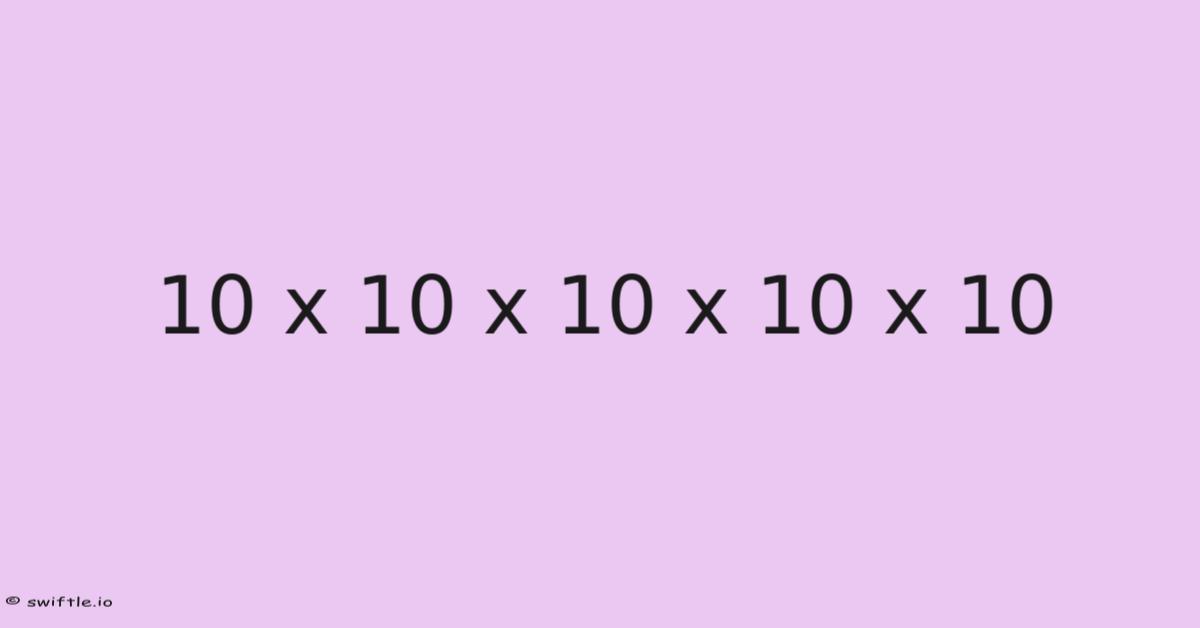
Ever wonder what happens when you multiply 10 x 10 x 10 x 10 x 10? Think about it: it feels like a simple arithmetic drill, but the result — 100,000 — pops up in places you might not expect. Maybe you’re counting inventory, estimating file sizes, or just curious about the power of ten. In this article we’ll unpack the meaning behind that string of tens, explore why it matters, break down how it works, point out common slip‑ups, and share practical tips that actually help you use the number without getting lost in the math.
What Is 10 x 10 x 10 x 10 x 10
The Basic Idea
At its core, 10 x 10 x 10 x 10 x 10 is just a series of multiplications. You start with ten, multiply it by ten again, and keep doing that until you’ve used five tens in total. The operation isn’t mysterious; it’s the same as taking ten and scaling it up five times.
The Numeric Value
When you crunch the numbers, you get 100,000. That’s a tidy round figure — one followed by five zeros. It’s the kind of number that feels both huge and manageable, depending on the context. In scientific notation, it’s written as 1 × 10⁵, which tells you exactly how many zeros are involved.
Real‑World Context
You’ll see this value in a variety of everyday settings. A typical paperback book might have about 200 pages, so 100,000 pages would fill roughly 500 shelves. In finance, a portfolio worth $100,000 is often considered a modest milestone for many investors. Even in technology, a 100,000‑byte file is a sizeable document but still far from a gigabyte.
Why It Matters / Why People Care
Everyday Relevance
Understanding that 10 x 10 x 10 x 10 x 10 equals 100,000 helps you gauge scale without pulling out a calculator. If you’re planning a party and need to estimate how many napkins to order, knowing the magnitude of a hundred thousand can guide you toward the right order of magnitude — perhaps a few thousand rather than a few hundred.
Business And Finance
In the business world, hitting the $100,000 mark can signal a turning point. A small startup might celebrate its first $100,000 in revenue, while a larger company might use that figure as a benchmark for a new project budget. Recognizing the significance of the number helps you set realistic goals and communicate expectations clearly.
Data And Technology
When dealing with data, 100,000 often appears as a threshold for “large” datasets. Here's a good example: a dataset with a hundred thousand rows might trigger performance considerations in a database. In file storage, a 100,000‑byte file is a common size for a high‑resolution image or a short video clip. Knowing the number lets you anticipate storage needs, processing time, and bandwidth requirements.
How It Works (or How to Do It)
Step‑by‑Step Multiplication
Start with the first ten: 10. Multiply by the second ten: 10 × 10 = 100. Take that result and multiply by the third ten: 100 × 10 = 1,000. Continue: 1,000 × 10 = 10,000, then 10,000 × 10 = 100,000. Each step simply adds another zero, which is why the process feels almost automatic after a few tries.
Using Exponents
Instead of writing out the whole chain, you can express it as 10⁵. The exponent tells you how many times the base (10) is multiplied by itself. So 10⁵ = 10 × 10 × 10 × 10 × 10. This shorthand is handy when you need to write the expression quickly or when you’re working with larger exponents.
Quick Mental Math Tricks
If you’re comfortable with zeros, you can think of each multiplication as appending a zero. Ten has one zero, so each time you multiply by ten you add another zero to the end of the number. Five tens means you add five zeros to the original “1,” turning it into “100,000.” It’s a neat shortcut that saves time, especially when you’re doing mental calculations on the fly.
Common Mistakes / What Most People Get Wrong
Assuming It’s Just a Big Number
Some folks glance at 10 x 10 x 10 x 10 x 10 and think, “That’s just a big number, what’s the point?” That mindset overlooks the practical implications. Recognizing that the number represents a specific magnitude can change how you approach a problem, whether you’re budgeting, planning a project, or analyzing data.
Continue exploring with our guides on how many days is 72 hours and how many glasses of milk in a gallon.
Overlooking Place Value
A frequent slip is misreading the place value of each zero. As an example, someone might think the result is 10,000 instead of 100,000 because they miscount the zeros. Paying attention to how many zeros you add at each step prevents this error.
Misreading the Expression
Another mistake is treating the expression as a single operation rather than a series of multiplications. If you mistakenly interpret it as “10 × (10 × 10 × 10 × 10),” you’ll still get the same answer, but you might get confused when the expression gets more complex. Keeping the order clear helps avoid algebraic errors.
Practical Tips / What Actually Works
Break It Down
When you need to calculate 10 x 10 x 10 x 10 x 10 in a real‑world scenario, break it into smaller chunks. Multiply the first two tens, then the next two, and finally combine the results. This stepwise approach reduces the chance of arithmetic slip‑ups.
Use a Calculator Wisely
If you’re dealing with larger exponents or need precision, a basic calculator can handle the multiplication instantly. Just be sure to press the equals button after each step if you’re doing it manually, to avoid carrying forward an incorrect intermediate result.
Apply It in Real Situations
Think about how you might use 100,000 in a project. If you’re estimating the number of emails you’ll send in a month, you could set a target of 10,000 per week, which adds up to 40,000, and then add another 60,000 for special campaigns. Seeing the number in context makes it more than just a mathematical curiosity.
FAQ
What Does 10 x 10 x 10 x 10 x 10 Equal?
It equals 100,000, which is also written as 1 × 10⁵ in scientific notation.
How Do You Write This as a Power?
You write it as 10⁵. The “5” is the exponent, indicating five tens multiplied together.
Can You Do This in Your Head?
Yes, by adding a zero for each multiplication. Start with 10 (one zero), then 100 (two zeros), 1,000 (three zeros), 10,000 (four zeros), and finally 100,000 (five zeros).
Why Do We Use Five Tens?
Five tens give you a round figure with five zeros, which is useful for counting, budgeting, or estimating large quantities without needing to write out many zeros.
Is This Used in Science?
Absolutely. In fields like astronomy, 10⁵ can represent distances in meters or counts of particles. In biology, a population of 100,000 organisms might be studied in a small ecosystem.
Closing
So there you have it — 10 x 10 x 10 x 10 x 10 isn’t just a string of numbers; it’s a gateway to understanding scale, a tool for clear communication, and a reminder that even simple multiplication can have real‑world impact. Whether you’re crunching numbers for a budget, estimating data storage, or just satisfying curiosity, knowing exactly what that product equals empowers you to think bigger and work smarter. Keep this insight in your toolkit, and the next time you see a string of tens, you’ll know exactly what it means.
