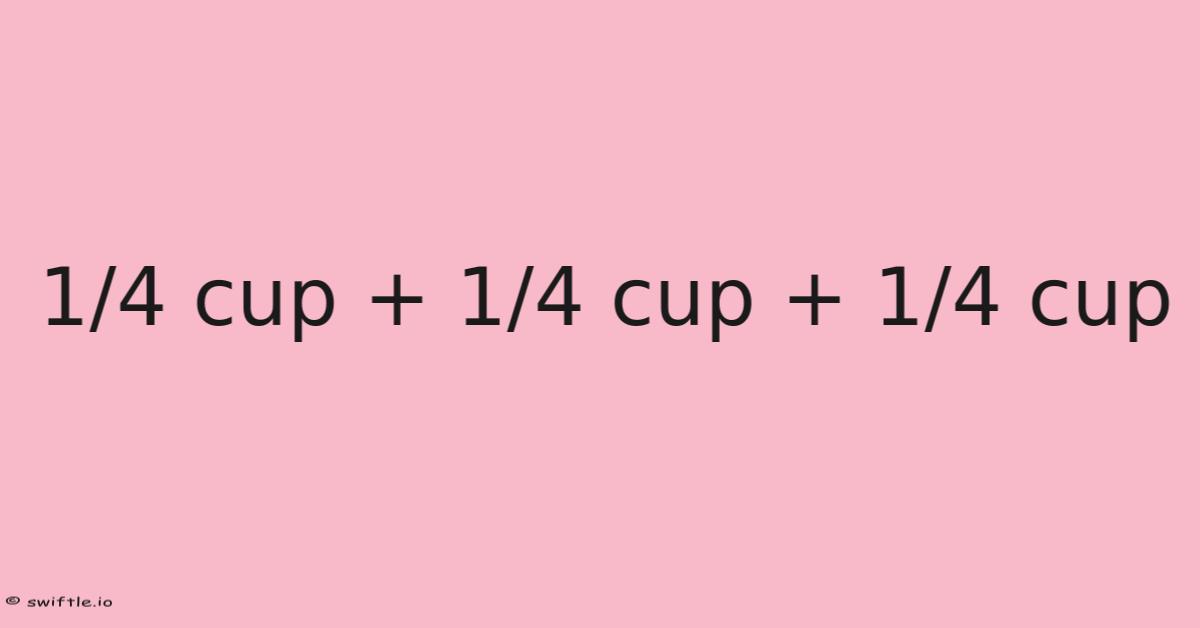
1/4 Cup + 1/4 Cup + 1/4 Cup = More Than You Think
You’re standing in your kitchen, staring at a recipe that calls for three 1/4 cups of something. Maybe it’s oil, maybe it’s sugar, maybe it’s a spice you’ve never used before. On top of that, you grab your measuring cup, pour in the first 1/4 cup, then the second, then the third. But wait—how much is that, really? Plus, is it 1 cup? Consider this: 3/4 cup? Something else?
Turns out, this is one of those deceptively simple questions that trips up even experienced cooks. Math isn’t everyone’s strong suit, especially when you’re juggling a dozen other things in the kitchen. And honestly, that’s okay. But understanding how fractions work in cooking can save you from a lot of guesswork—and maybe even a ruined dish or two.
So let’s break it down. Not just the math, but the why behind it, and how to make it work for you in real life.
What Is 1/4 Cup + 1/4 Cup + 1/4 cup?
At its core, this is basic fraction addition. But in the kitchen, numbers don’t always feel intuitive. Worth adding: one-fourth plus one-fourth plus one-fourth equals three-fourths. That’s why it helps to think in terms of volume.
A 1/4 cup is a standard measuring cup size, equal to 4 tablespoons or about 60 milliliters. So when you add three of them together, you’re looking at 12 tablespoons total—that’s 3/4 cup. It’s not magic, just math.
But here’s the thing: measuring cups come in different sizes, and not everyone owns a 3/4 cup measure. If you’re working with a 1/4 cup scoop, you might end up with three separate pours, which can lead to slight inaccuracies if you’re not careful.
Understanding Fractions in the Kitchen
Fractions are the backbone of cooking measurements, but they’re not always straightforward. Here's a good example: 1/4 cup is half of 1/2 cup, which is half of a full cup. This hierarchy makes it easier to scale recipes up or down.
But when you start adding fractions, things can get tricky. Now, three 1/4 cups equal 3/4 cup, yes—but if you’re doubling a recipe that calls for 1/4 cup, you’d need 1/2 cup, not 1/4 + 1/4. It’s easy to mix up, especially when you’re in a rush.
Converting to Tablespoons and Teaspoons
Here’s where it gets practical. Since 1/4 cup equals 4 tablespoons, three of them equal 12 tablespoons. That’s the same as 3/4 cup. If you don’t have a 3/4 cup measure, you can use a 1/4 cup measure three times, or switch to tablespoons.
But here’s a pro tip: 12 tablespoons is also 36 teaspoons. Think about it: that’s a lot of spooning. So unless you’re in a pinch, stick to the 1/4 cup method.
Why It Matters / Why People Care
Getting measurements right isn’t just about following a recipe—it’s about consistency. Baking, in particular, is a science. Too much or too little of an ingredient can throw off the entire balance.
Imagine making a batch of cookies that calls for 3/4 cup of butter. Which means if you accidentally use 1 cup instead, your cookies might spread too much or turn out greasy. On the flip side, if you use only 1/2 cup, they could be dry or crumbly. These small differences add up.
But it’s not just baking. In savory cooking, precise measurements matter too. A sauce that’s too acidic or too salty can ruin a dish. And when you’re scaling recipes—for a crowd or for meal prep—understanding how to add fractions correctly saves time and reduces waste.
Real Talk About Recipe Scaling
Scaling recipes often involves fractions. If a recipe serves four and you need to serve twelve, you’re tripling it. So that means 1/4 cup becomes 3/4 cup. If you’re not comfortable with fractions, you might end up eyeballing it, which can lead to inconsistent results.
I’ve been there. I
I’ve been there, too—standing in front of a pantry that feels more like a puzzle box, trying to piece together a missing ¾‑cup of milk just to get that next batch of pancakes to rise properly. The trick is to keep a mental map of the common fractions and their equivalents.
Quick Reference Cheat Sheet
| Fraction | Cup | Tablespoons | Teaspoons |
|---|---|---|---|
| ¼ | ¼ cup | 4 tbsp | 12 tsp |
| ½ | ½ cup | 8 tbsp | 24 tsp |
| ¾ | ¾ cup | 12 tbsp | 36 tsp |
| 1 | 1 cup | 16 tbsp | 48 tsp |
Keep this handy or print it out next to your measuring set. When you glance at a recipe, you can instantly convert without pausing to calculate.
Tools That Make Fraction Work Easier
- Graduated Measuring Cups – Many sets come with ¼, ½, and ¾ cup marks. Even if you only have a ¼ cup, you can simply fill it three times.
- Digital Kitchen Scale – Weighing ingredients in grams or ounces eliminates the need to juggle fractions. A 200‑gram butter is easier to handle than “¾ cup.”
- Measuring Spoons Set – If you’re missing a cup measure, use 1‑tablespoon spoons to build up to the desired volume. Three 4‑tablespoon servings equal ¾ cup.
When Accuracy Isn’t Just a Nice‑to‑Have
- Baking – Leavening agents (baking powder, soda) are highly sensitive to volume. One extraGPT tablespoon can make a cake collapse or become too dense.
- Fermentation – Yeast dough requires precise ratios of flour, water, and yeast. A miscalculation can result in over‑proofing or a flat loaf.
- Nutrition – If you’re tracking macros, even a small deviation in oil or nut butter can shift your daily totals.
A Few Final Tips
- Measure Dry Ingredients First – They’re easier to level off with a straight edge. Wet ingredients can be measured by volume or weight, but dry measurements give you a consistent baseline.
- Use the “Level‑off” Method – After filling a cup, tap it lightly and then level the surface with a knife. This avoids “top‑off” errors that inflate the volume.
- Practice Makes Perfect – The more you measure, the more intuitive fractions become. Over time, you’ll be able to eyeball a ¾ cup of flour in a bag without hesitation.
In a Nutshell
Fractions are the silent backbone of every kitchen. Plus, with a little practice, those fractions will feel less like math and more like the natural rhythm of cooking. Keep a simple reference chart nearby, invest in a reliable set of measuring tools, and remember that even a small slip in volume can ripple through the final result. Still, whether you’re whisking a ¾‑cup of vanilla extract into a custard or scaling a soup recipe for a holiday feast, understanding how to convert and measure accurately keeps your dishes consistent and delicious. Happy measuring!
Want to learn more? We recommend how many square inches in a square foot and how many sides does a dodecagon have for further reading.
At the end of the day, mastering fractions in the kitchen isn’t just about precision—it’s about building confidence in your cooking. Every time you adjust a recipe, troubleshoot a measurement, or scale ingredients for a crowd, those fraction skills become second nature. But the next time you’re in the kitchen, try measuring a new recipe without glancing at the chart. Also, you might surprise yourself with how naturally the numbers fall into place. And remember, the goal isn’t perfection—it’s progress. With each dish you create, you’re not just feeding bodies; you’re nurturing a skill that brings joy, creativity, and connection to every meal. Happy cooking!
Bridging Metric and Imperial Systems
- Know Your Common Equivalents – While 200 grams of butter is straightforward, not all ingredients have a 1:1 conversion. Here's one way to look at it: 1 cup of all-purpose flour weighs roughly 120 grams, so ¾ cup would be about 90 grams. Keep a cheat sheet of these conversions handy for quick reference.
- Use Kitchen Scales for Precision – If you frequently switch between systems, a digital scale can save time and reduce guesswork. Measure ingredients like nuts, chocolate, or grains by weight for consistency, especially in baking.
- put to work Online Converters – Websites and apps like "Kitchen Calculator" or "ConvertUnits" can instantly translate measurements, helping you adapt recipes from different sources without mental math.
In a Nutshell
Fractions are the silent backbone of every kitchen. Whether you’re whisking a ¾‑cup of vanilla extract into a custard or scaling a soup recipe for a holiday feast, understanding how to convert and measure accurately keeps your dishes consistent and delicious. Consider this: keep a simple reference chart nearby, invest in a reliable set of measuring tools, and remember that even a small slip in volume can ripple through the final result. With a little practice, those fractions will feel less like math and more like the natural rhythm of cooking. Happy measuring!
Mastering fractions in the kitchen isn’t just about precision—it’s about building confidence in your cooking. Every time you adjust a recipe, troubleshoot a measurement, or scale ingredients for a crowd, those fraction skills become second nature. The next time you’re in the kitchen, try measuring a new recipe without glancing at the chart. Which means you might surprise yourself with how naturally the numbers fall into place. And remember, the goal isn’t perfection—it’s progress. With each dish you create, you’re not just feeding bodies; you’re nurturing a skill that brings joy, creativity, and connection to every meal.
By embracing fractions as an essential tool rather than a hurdle, you open up the freedom to experiment and innovate. Whether you’re a home cook or a seasoned chef, the ability to interpret measurements with ease transforms the kitchen into a space of possibility. So next time you’re faced with a tricky conversion or an unfamiliar fraction, take a deep breath and trust your instincts. Think about it: the math may seem daunting at first, but with practice, it becomes as effortless as breathing. After all, cooking is as much about intuition as it is about technique. Let those fractions guide you, and watch your culinary confidence grow with every meal.
