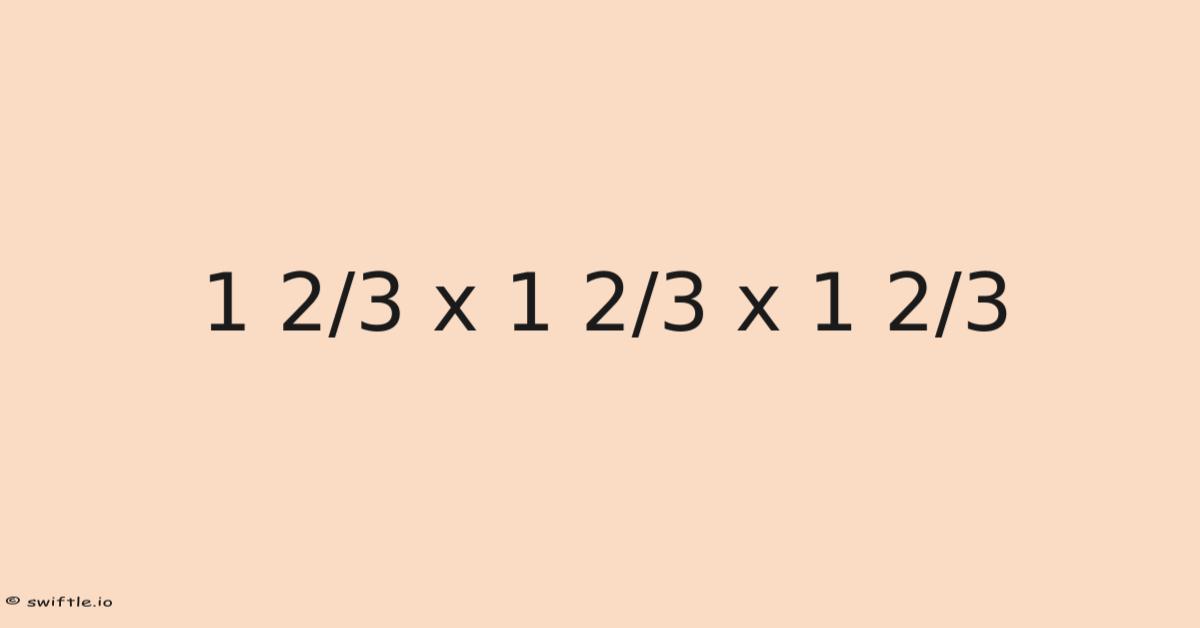
Why 1 2/3 x 1 2/3 x 1 2/3 Isn’t Just a Math Problem (And What It Actually Means)
Let’s say you’re in the kitchen, trying to scale up a recipe that calls for 1 2/3 cups of flour. You want to make three times the amount. So you multiply 1 2/3 by itself three times. Easy enough, right?
Not quite.
Most people hit a wall here. But this isn’t just about arithmetic — it’s about understanding how scaling works in real life. They either freeze at the fraction multiplication or guess the answer and hope for the best. Whether you’re cooking, building, or budgeting, getting this right matters.
Here’s the thing: 1 2/3 x 1 2/3 x 1 2/3 equals 125/27, or roughly 4.63. But that number only tells part of the story. Let’s break down what this really means and why it’s worth knowing.
What Is 1 2/3 x 1 2/3 x 1 2/3?
At its core, this is a multiplication problem involving mixed numbers. A mixed number combines a whole number and a fraction — in this case, 1 and 2/3. To solve it, you first convert the mixed number to an improper fraction.
1 2/3 becomes 5/3. Then you multiply 5/3 by itself three times:
5/3 × 5/3 × 5/3 = (5 × 5 × 5)/(3 × 3 × 3) = 125/27.
If you convert that back to a mixed number, you get 4 17/27. In decimal form, it’s approximately 4.Still, 63. That’s the straightforward answer.
But here’s where it gets interesting. This calculation isn’t just a textbook exercise. It’s a practical tool for scaling quantities, whether you’re adjusting a recipe, calculating volumes, or working with proportions in design. Understanding how these numbers interact helps you avoid costly mistakes — like ending up with a cake that’s too dense or a project that’s off by inches.
Converting Mixed Numbers to Improper Fractions
Before diving into multiplication, it’s crucial to know how to convert mixed numbers. In practice, take 1 2/3. Also, multiply the whole number (1) by the denominator (3), then add the numerator (2):
1 × 3 + 2 = 5. So, 1 2/3 = 5/3.
This step is where many people stumble. They forget to multiply the whole number by the denominator, leading to incorrect fractions. Once you’ve got that down, the rest falls into place.
Multiplying Fractions Step by Step
Multiplying fractions is simpler than it looks. Multiply the numerators together and the denominators together. For 5/3 × 5/3 × 5/3:
Numerator: 5 × 5 × 5 = 125
Denominator: 3 × 3 × 3 = 27
So, 125/27. Because of that, no common factors to simplify here, so that’s your final answer. But in practice, you might need to convert it back to a mixed number or decimal for real-world use.
Why It Matters (And Where People Go Wrong)
Why does this calculation matter beyond the classroom? Because scaling isn’t just about multiplying numbers — it’s about maintaining ratios. If you’re making three times a recipe, every ingredient needs to scale proportionally. Mess this up, and your dish could be a disaster.
Imagine you’re baking cookies and need to triple the recipe. Also, the original calls for 1 2/3 cups of sugar. If you incorrectly calculate 1 2/3 × 3 as 3 2/3 instead of 5, you’ll add too much sugar. The cookies will be overly sweet and might not bake properly.
This principle applies to other areas too. Worth adding: in finance, miscalculating compound growth can skew projections. In construction, scaling dimensions incorrectly can lead to materials that don’t fit. The key is understanding that scaling involves more than just multiplication — it’s about maintaining the right proportions.
Real-World Applications
In cooking, scaling recipes is a daily task. Day to day, whether you’re doubling a soup recipe or halving a cake mix, accurate calculations ensure consistency. To give you an idea, if a recipe serves 4 and you need to serve 12, you multiply each ingredient by 3. But if an ingredient is 1 2/3 cups, you need to know that 1 2/3 × 3 = 5 cups, not 3 2/3.
In manufacturing, scaling production requires precise calculations. If a product requires 1 2/3 units of material per item, producing 100 items means needing 166.Day to day, 67 units (rounded to two decimal places). Underestimating this can lead to shortages and delays.
How to Multiply 1 2/3 x 1 2/3 x 1 2/3 (Step by Step)
Let’s walk through the process. It’s straightforward once you break it down.
Step 1: Convert Mixed Numbers to Improper Fractions
Start by converting 1 2/3 to an improper fraction. In practice, multiply the whole number (1) by the denominator (3), then add the numerator (2):
1 × 3 + 2 = 5. So, 1 2/3 = 5/3.
Step 2: Multiply the Fractions
Now multiply 5/3 by itself three times:
5/3 × 5/3 = 25/9
25/9 × 5/3 = 125/27
Step 3: Convert Back to a Mixed Number or Decimal
125 divided by 27 is 4 with a remainder of 17. So, 125/27 = 4 17/27. Also, as a decimal, that’s approximately 4. 63.
Continue exploring with our guides on how many ounces in 3 liters and how many dimes in 5 dollars.
Step 4: Apply to Real-World Scenarios
If you’re scaling a recipe by 1 2/3, and the original calls for 2 cups of flour, you’d multiply 2 × 1 2/3. Convert 1 2/3 to 5/3, then multiply:
2 × 5/3 = 10/3 = 3 1/3 cups.
This step-by-step approach ensures accuracy, especially
This step-by-step approach ensures accuracy, especially when dealing with complex scaling tasks where even minor errors can compound. This method isn’t just a mathematical exercise—it’s a practical tool that empowers people to make informed decisions in everyday life. Whether you’re adjusting a recipe, managing project budgets, or scaling industrial processes, precision in scaling preserves the integrity of outcomes. By mastering the conversion of mixed numbers to improper fractions, multiplying systematically, and reconverting results, individuals gain a reliable framework for handling proportional adjustments. By applying these principles consistently, we avoid costly mistakes and see to it that our scaled results align with real-world expectations. The key takeaway is that scaling isn’t merely about numbers; it’s about understanding relationships and maintaining balance. In a world where ratios and proportions underpin so much of our activities, the ability to scale correctly is not just useful—it’s essential.
Leveraging Technology for Scaling Complex Ratios
Modern calculators and spreadsheet programs can automate the conversion and multiplication of mixed numbers, but understanding the underlying process remains essential. When a recipe calls for a fractional quantity that must be scaled by a non‑integer factor—such as 1 ⅔—simply entering “1 ⅔ × 1 ⅔ × 1 ⅔” into a calculator will yield the correct result, yet the user must still verify that the input was interpreted correctly.
Spreadsheets offer an added layer of control: by placing the original quantity in one cell and the scaling factor in another, formulas can automatically recalculate the adjusted amount whenever the scaling factor changes. This dynamic approach is especially valuable in manufacturing environments where production volumes shift frequently, and the same material ratio must be applied across multiple product lines.
Common Pitfalls and How to Avoid Them
-
Rounding Too Early – Performing intermediate rounding can introduce cumulative errors. In the example of 1 ⅔ × 1 ⅔ × 1 ⅔, rounding 5/3 to 1.67 before multiplying would produce 1.67³ ≈ 4.63, which is close but not exact. To preserve accuracy, keep calculations in fractional form until the final step.
-
Misidentifying the Scaling Factor – In collaborative projects, it is easy to confuse the desired final quantity with the multiplier. Clearly defining whether the factor represents “how many times larger” or “what proportion of the original” prevents mis‑scaled outcomes.
-
Overlooking Units – Scaling a quantity without accounting for its unit of measure can lead to nonsensical results. Multiplying 1 ⅔ cups by 1 ⅔ yields a volume, but if the same factor were mistakenly applied to a weight measurement, the resulting figure would be meaningless. Always align the units before performing the multiplication.
Practical Applications Beyond the Kitchen
- Construction Estimates – When ordering lumber, a contractor may need to cut boards to a length that is 1 ⅔ times the standard size. Accurate scaling ensures that material waste is minimized and that the final structure meets design specifications.
- Pharmaceutical Dosage – Dosage calculations often involve multiplying a base dose by a factor that may be expressed as a mixed number. Precision here directly impacts patient safety.
- Financial Modeling – Growth projections frequently assume a compounded increase expressed as a mixed‑number rate. Correctly scaling these rates over multiple periods yields realistic forecasts and informs investment decisions.
Building a Scaling Mindset
The ability to scale quantities accurately is more than a computational skill; it cultivates a mindset of proportional reasoning. And by consistently asking, “What is the relationship between the original amount and the desired amount? ” individuals develop an intuitive feel for how changes in one part of a system ripple through the whole. This habit of questioning and verifying relationships encourages meticulousness in documentation, clear communication of assumptions, and a disciplined approach to problem‑solving.
Conclusion
Scaling numbers such as 1 ⅔ may appear elementary, yet the process encapsulates a broader principle: precision in proportional reasoning underpins success across countless domains. Plus, from the home cook adjusting a family‑size stew to engineers designing a scalable production line, the same foundational steps—converting mixed numbers, multiplying methodically, and validating results—apply universally. Embracing these steps, while remaining vigilant about rounding, units, and the context of the scaling factor, equips us to handle both simple and complex adjustments with confidence. The bottom line: mastering the art of scaling transforms raw numbers into reliable tools, enabling us to translate intention into action without error, and ensuring that every multiplied quantity delivers the intended outcome.
